The best tradition

Every year our friend Russell and his wife Carmen invite their friends and family to gather at their house and cut Christmas trees on their property.  Russ puts hay bales on his wagon for most of us to ride on out to the power line.  I must admit that this ride borders on scary for me – open wagon, crowds of people, rutted, steep road.  As Carmen told one of her daughters who was afraid of falling off (or tipping over), “It’s all part of the experience.”

Getting the Tree (3)

Once out on the power lines everyone fans out to find that perfect tree.  We all have something in mind, the trees we cut seem just right until we get them to the car and realize they might be a little bigger than we thought.  We cut extras for people not there.
Getting the Tree (4)

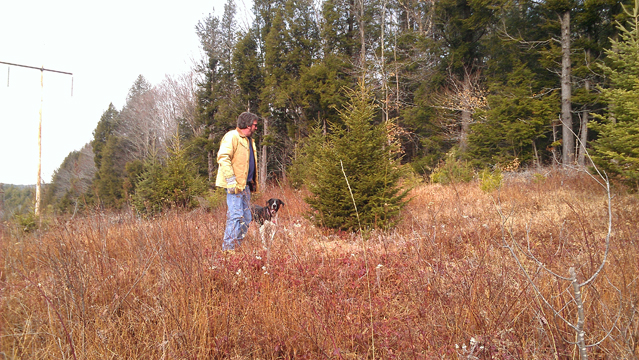
This was Chester’s second tree outing.  He was in heaven.  Although he stays around Bill he is especially fond of the kids.  This seems to be his job, to help any child overcome any budding fear of dogs.  One of the gentlest animals I’ve ever known.
Getting the Tree (2)

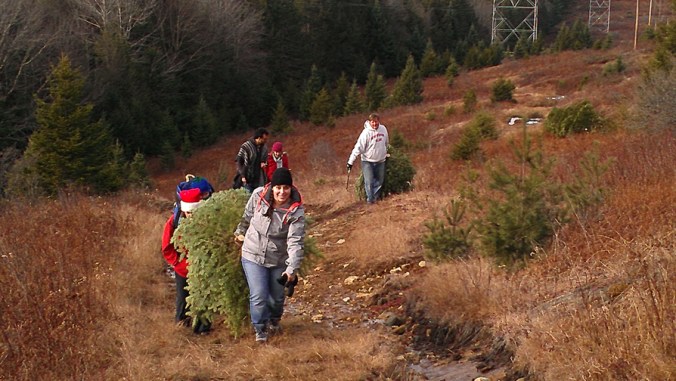
Once everyone has their tree it’s time to bring them back to the trailer.  This is where I think that you should pick the first tree that strikes your fancy otherwise you have to carry it a long, uphill way to get it loaded for the return trip.  Many hands make light work they say so the long walk wasn’t too bad.

Getting the Tree (1)


The tractor and trailer make their way back to the farm and we all walk behind it.  This is my favorite part of the day.  Russell’s farm is on the top of a hill that allows you to see some beautiful views.  In the mowin’ you feel like you are on top of the world.

Truth be told my favorite part of the day is watching Russell.  He looks forward to this event probably more than any other.  He is surrounded by all of this favorite people.  His children, grandchildren, friends and family – he beams.  As we sat around the kitchen table drinking hot chocolate and eating the soups and chili we caught up on our lives.  We met children we’d only seen photographs of.  This is a holiday tradition that brings nothing but lightness and laughter regardless of the subject of conversation.  We all enjoy each others company.  We may see some of these people during sugar season or bump into them at a local watering hole but it’s only when we get our tree that all of us get together and laugh.
 

Messages from Friends

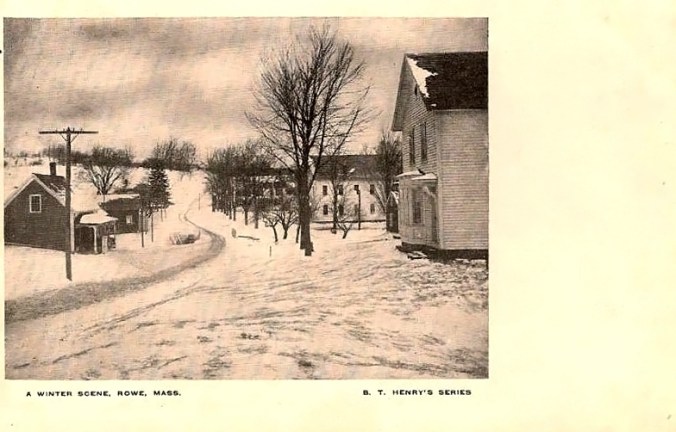
Winter Scene 1905

Winter Scene Postcard from about 1910

I’ve had this postcard for a number of years.  I found it on Ebay and it was unused.  I have others with notes to friends while the authors spent some time relaxing in the quiet that is Rowe.  Around the turn of the century Rowe was quite the vacation destination and the people that came to visit really were very fond of this little town.  Poems were written, postcards and letters were sent.  All espousing the virtues of quiet and clean air.  The people that received these cards kept them and years later they made their way onto the market by way of the internet.  I supposed in years past they would have ended up in a tag sale or perhaps in a small antique shop somewhere.  I have to confess to spending hours in local antique shops going through photos and ephemera from local residents long gone.

These messages to friends were sent all up and down the eastern seaboard.  It’s hard to say how long they took to get to their destinations.  I remember sending cards on the first day of a vacation and they’d arrive at their destinations the day we got home.  Most of these cards cost a penny to mail.

In the past couple of weeks I’ve made some new friends on Facebook.  It’s done an interesting thing to what I post and what I’ve been watching and commenting on.  The friendships are from a number of different places both geographically and in my life.  Some from high school, some from photography school, some from the life I’m living right now.  All of them are from the gentlest of people who are seeing the same things I am right now which is the need to slow down and bring everything closer.  We all are seeing a need to build communities of like minded people, mostly to help us maintain our sanity I think.  There is so much craziness around us all the time and we are all trying to build something slow, something sustainable for ourselves in our own space.  At the same time we understand the need for a community of like minded people that let us know we aren’t insane for thinking  this is a possibility and that share their wisdom to help move the dream along.

The real irony in this for me is the fact that I’m using social media and blogging to connect with these people in a way that simply would not happen otherwise.  So the thing that sometimes makes me crazy is also what makes this small community possible.

“The Internet has turned what used to be a controlled, one-way message into a real-time dialogue with millions.” – @daniellesacks 

The pain of the learning curve

121127 Warping Towels

Warping board with cotton warp.

A few months ago I bought a 36″ 4 harness Harrisville loom from a friend who was moving.  She posted it on Facebook asking if anyone was interested.  The second I saw it I said sure and the rest is history.

Let’s start by saying the only weaving I have ever done is a potholder.  I’m a good potholder maker, everything is neat and I work on design with color but it’s a potholder.  I come from a long line of weavers so my take on this was it’s probably genetic, I’ll find a teacher and run with it.  I found Firewatch Weavers on the internet and sent in my deposit.  I was thrilled to find someone that teaches on a Harrisville.  I took Pam’s first 6 week course and warped and wove a sampler.

Next project – cotton towels with a twill weave.  Cool I’m thinking.  She always has us do a worksheet to figure out the warp before we begin.  I understood what I was doing and I began winding my warp.  I had limited time at the studio that night so I left at 9:00 pm and decided to return in a couple of days to finish winding.  Pam told me I’d probably have to wind it in two sections because I wouldn’t have enough room on the warping board for the whole thing.  When I returned I took off the first half of the warp and began winding the second half.  I was almost finished when she asked me how wide my towels were.  14 inches I replied and saw this look on her face, then a smile.  I’d warped enough to do the project twice!  Ugh, is what I initially thought but then she said well now you can warp your loom in Rowe and weave it at the same time!

Lesson learned.  Warping can be pretty tedious although it is probably the most important part of weaving, at least from a design stand point.  There are 12 other weavers in the studio at any given time, all of which are at different skill levels.  One of my favorite things is going from loom to loom discussing each project and then the ways that many of them have screwed up their warp and ultimately were in a bind when they started weaving.  Lessons learned, just not necessarily on my loom.

In the coming weeks I’ll be talking about setting up the loom in the library in Rowe and the adventures that I am sure are going to follow.  Some include working in the wood shop to create tools to help me with the weaving.  This should be interesting.

On Knitting

121202 Sock knitting

“…the number one reason knitters knit is because they are so smart that they need knitting to make boring things interesting. Knitters are so compellingly clever that they simply can’t tolerate boredom. It takes more to engage and entertain this kind of human, and they need an outlet or they get into trouble.

“…knitters just can’t watch TV without doing something else. Knitters just can’t wait in line, knitters just can’t sit waiting at the doctor’s office. Knitters need knitting to add a layer of interest in other, less constructive ways.” ― Stephanie Pearl-McPhee

The true brilliance of Jenna Woginrich is her understanding that the people that are drawn to her and her blog Cold Antler Farm are interested in doing things.  Her workshop last weekend invited attendees to bring a knitting project to work on while presentations were being made.  I have to admit that was one of the driving forces that got me there.  People sitting around knitting while the speakers spoke their piece showed me that Jenna got it.  She understands that there are many of us that always need something to do with our hands.  Knitting helps me think, helps me absorb what is happening around me and many times helps me feel like sitting around isn’t time wasted because there is an end product.

More people need to take the time to learn to knit.  If they know how they need to have some little project that they can keep with them for those quiet moments.  Knitting is a type of meditation.   The feel of the wool in your fingers, the quiet clicking of the needles, the surprise when it all comes together, the pride in the finished project.  It allows you to concentrate on a problem or pay close attention to a conversation even though the other party may feel like they are being ignored.

I remember having to do laundry in a laundromat back in the small apartment days.  I always said that I didn’t mind because anyone that came from Rowe could not be bored.  It really was because I always had some sort of handwork going.  A ball of yarn didn’t cost much, kept me entertained and I’d have a Christmas present for someone.  They didn’t need to know the hours I spent in a laundromat creating the thing.

121202 Sophie on the couch

Of course this is how Sophie sees knitting.

Heirloom

Table with runner

heir·loom

noun \ˈer-ˌlüm\

1: a piece of property that descends to the heir as an inseparable part of an inheritance of real property

2: something of special value handed on from one generation to another

3: a horticultural variety that has survived for several generations usually due to the efforts of private individuals

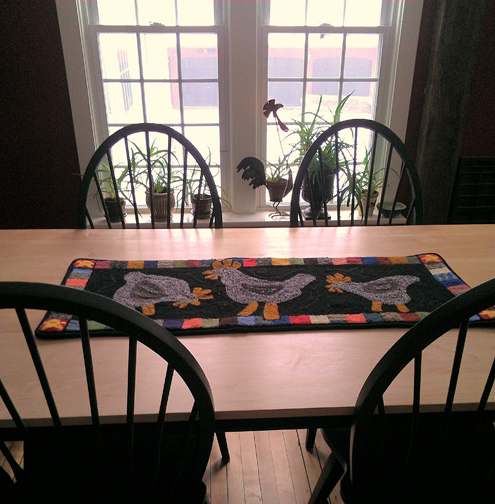
On Sunday I posted this photograph to Facebook with the comment – new heirlooms.  The table was just finished by lifelong friend Russell Donelson.  He’s a contractor but is one of the best finish carpenters I know and he loves doing it.  He knew I wanted a table 3 years ago when we were doing the renovation on the room it’s in.  He got the rough lumber from a neighboring town and had it drying in his barn – waiting.  I had the base made in Vermont because the price was right and I wanted turned legs which Russell thought was a good idea.  He then went to work on the top.  The Friday before Thanksgiving I arrived at the house to see it sitting in the living room.  Visually it’s beautiful but when you touched it it was like silk.  I spent the next two days oiling and waxing and getting to know my new table top.  Rubbing and reading the wood.  This is one beautiful piece of furniture and is wonderful that it was made by a good friend who took pride not only in his work but in the provenance of the wood.

The hooked mat I made while Russ was making the table, it was a large surface that would be screaming for a runner.  I’ve just begun hooking rugs and thought this would look good.  It was a challenge I gave myself to get it finished by the time the table came into the living room.  It’s fun, relatively practical and I was only a week off in finishing it.

I was thinking about the things we put value on and why.  For me it’s so much of an emotional thing.  The table means a lot to me because of Russell but I also envision gatherings around it to eat, converse, play board games, bond with family and friends.  Over time it will mean much more to me then it does now and I’m hoping it will mean more to others as well.

The runner I see as one of those things that will be on the table for a while then be relegated to the closet until such a time when things are cleaned out and it gets passed to someone else who has a sentimental attachment to it because some great grandmother in the distant past made it.

There is a silver sugar spoon that my mother always had in her sugar bowl – it’s still in the kitchen.  On the handle are the initials W.R.C.  She told me that she always hoped that it belonged to some long lost relative but came to the realization that it stood for “Women’s Relief Corp”.  She always laughed about it.  Not too long ago I found a silver sugar spoon in the attic with all of  my great grandmother’s things and brought it home to use in my kitchen.  The initials on the handle are L.G.D.  I was doing some research on the Gilbert side of my family tree when I realized that the spoon had belonged to Lydia Gilbert Duncan (1811-1898), my third great aunt.  It was one of those fantastic moments of discovery in the family tree world but all I could think about was my mother wanting that family heirloom and it had been sitting in her attic all along.

“Family stories make the most valuable heirlooms.” (Author unknown)

A Matter of Style

Adirondacks in the snow


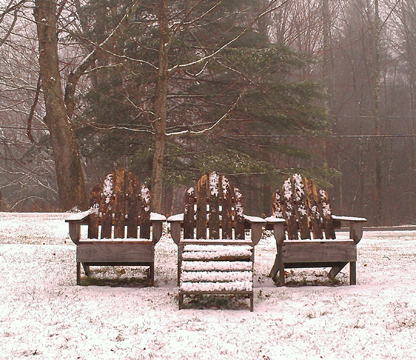
On Sunday I decided it was time to get serious about this blog and have it be a repository of so many things about Rowe and Fort Pelham Farm.  This includes being more diligent with my photography.  I don’t know if it is because I was a photographer for so many years in a commercial situation where value was placed on minimal shots due to the expense of film and processing or that I just don’t place that much value on it anymore but I’ve all but stopped taking photographs.


This became so clear to me over the past weekend at a Words and Wool workshop I attended at Cold Antler Farm.  Jenna Woginrich had put together my dream day with her and two other bloggers I read every day.  They were all full of amazing information but also such dedication to their writing and their blogs.  The eye opener for me came from Jon Katz after the workshop broke and we were walking around Jenna’s farm.  He is fairly new to photography and was snapping away while we were outside.  I complemented him on his growth and style that I have been watching over the past few years.  He thanked me and said how much he loved the camera he was using and wanted to know what I shot with.  Dear God I thought, my phone, Instagram.  I was a little embarrassed.  We went on to talk about the quality of light and chasing it.  It was quite wonderful for me to meet such a gentle and generous man.


On the drive home though all I could think about was the difference between his style and mine.  He told me that sometimes he doesn’t even know he has a good photograph until he sees it on his computer, so much of it was luck.  I really think this is the difference in photographers that have spent their lives using film and the photographers that have come into it during the digital age.  Don’t get me wrong, I love my digital cameras.  Digital sets you free in a lot of respects, your shots are unlimited these days.  But is that really the way to be?


There was a light snowfall overnight Saturday to Sunday and I decided to take my phone (yes, my phone) out and take a couple of shots to put on Facebook.  My shots were limited, deliberate.  I didn’t load them onto a computer because there isn’t one available and part of me WANTS immediate results.  I also edit while I take photographs  – often deleting what I don’t want as I go along.  I probably took about 15 photographs in all yesterday and kept 8.  Of the 8 that I kept I would probably post 5.


I’m thinking maybe Jon has something good going on, everyone has their style, maybe I can really take something away from that experience.  Take more pictures.  I think maybe I’ll now look more at the opportunities to take a photograph but I don’t think I’m ever going to get away from trying to make every single shot count.  I think that method teaches you to slow down and see exactly what is in front of you and that, for me, is always what photography has been about.

Family History


I have been doing genealogy for well over 15 years.  These days I will do research obsessively for a few days then not come back to it for a few months.  There rarely are exciting breakthroughs anymore, I seem to be doing more cleaning up of things than finding new relatives and the new relatives I do find are so far removed that it almost isn’t worth writing them down.

Recently I decided to do the family tree of Fort Pelham Farm since Olive had written down so much about her family history.  All of what I had has to be considered oral history until it could be tied to public record so I started with Olive and worked my way back.  I now use Ancestry.com for most of my research because I can sit at my desk and pop in the information.  Through the miracle of the internet there  are records from our ancient past available at the click of a mouse, truly amazing.

I’ve been working on the Wright/Gould/Haynes tree for a while and today a name and place from the distant past popped up on the Gould side – Sarah Baker from Ipswich, MA born in 1640.  When I saw that she was from Ipswich in the mid 1600’s I wondered if my family and hers knew each other because so many of my mother’s relatives landed there at about the same time, so I opened my tree alongside of Olive’s.  My tree has an Elizabeth Baker born in Ipswich in 1645, they were sisters.  Our distant Ipswich relatives not only knew each other, they lived under the same roof.  John Baker (1598-1678) was Olive’s 5th great grandfather and my 9th.

I have known for a long time that if you trace someone’s lineage back far enough we are all related, this was just one of those happy little coincidences that make studying your family tree so much fun. (That and sometimes I feel like I work for CSI).  It also makes Fort Pelham Farm feel even more like a family home.

What’s in a Name?


A common question asked is why is this known as Fort Pelham Farm?

The original parcel of land (the entire town of Rowe) was originally sold by the General Court of the Commonwealth of Massachusetts to Cornelius Jones who later sold most of the land in 1779.

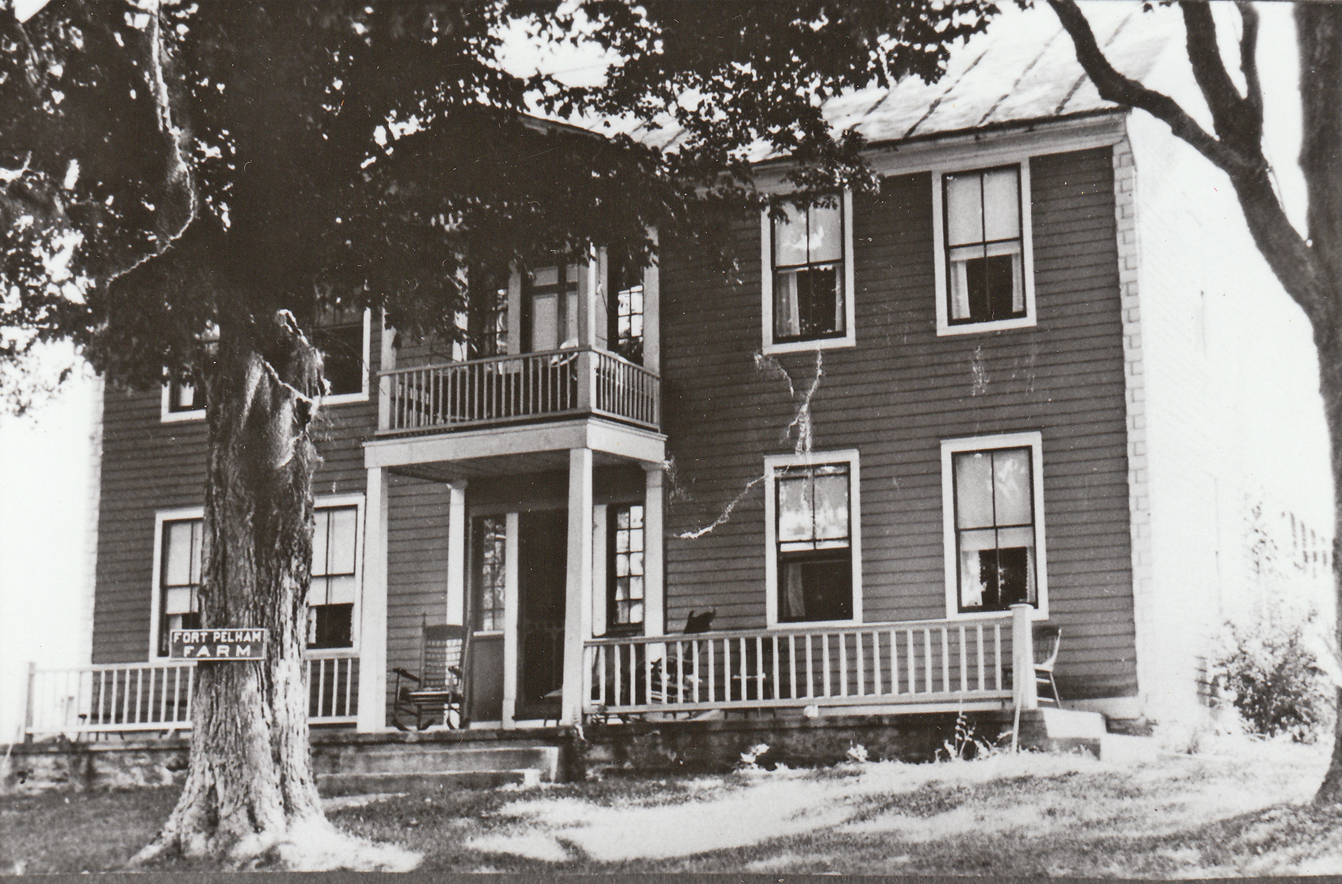
” The land transactions recoded in the Franklin County Registry of Deeds show that the next owner of the Fort Pelham site was Dr. Pardon Haynes of Rowe, the town physician from 1788 until his death in 1834.  His estate inventory indicates that he was not only a “gentleman,” but a wealthy one, and by the time of his death he had acquired a great deal of land over many years.  The heirs of Dr. Haynes sold the property during the 1840s and 1850s to the Gould family.  By the first two decade of the twentieth century, it had passed into the hands of Edward Wright when it was known as Fort Pelham Farm.  The Fort Pelham Farm was sold in 1942 to Florence E. Neal, who presented it to the Rowe Historical Society in 1956.  The site (which had been open pasture until about 1930) had returned to second-growth bush and trees, and was not easy for the casual visitor to find.  Today, much of the brush has been removed and the site is marked by a large boulder with an inscribed stone plaque.” From The Line of Forts  by Michael Coe


The reference to the Wrights is where the name comes in.  With the advent of better transportation the town of Rowe became somewhat of a vacation spot.  It was advertised as a place of peace and tranquility.  The brochure below was probably used in the early 1900’s.


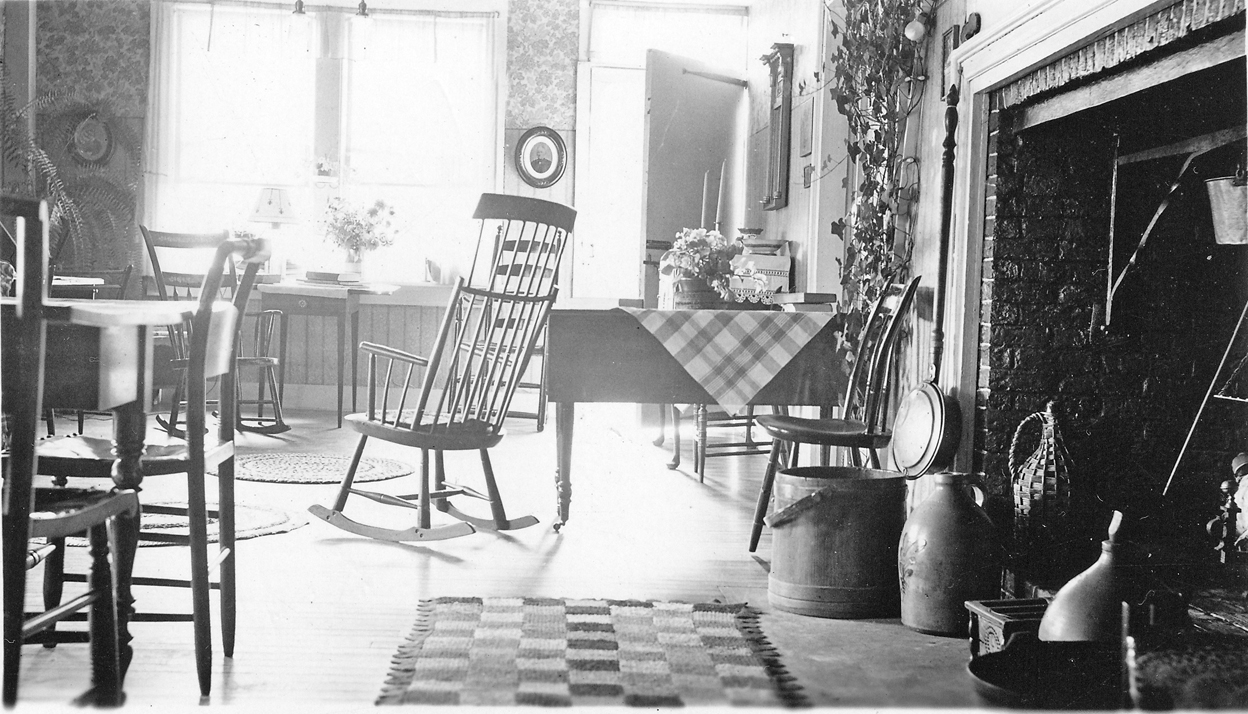
The dining room is the largest room in the house and remains very much the same as it was in 1900.  Photos show how it was set up for their infamous chicken dinners.


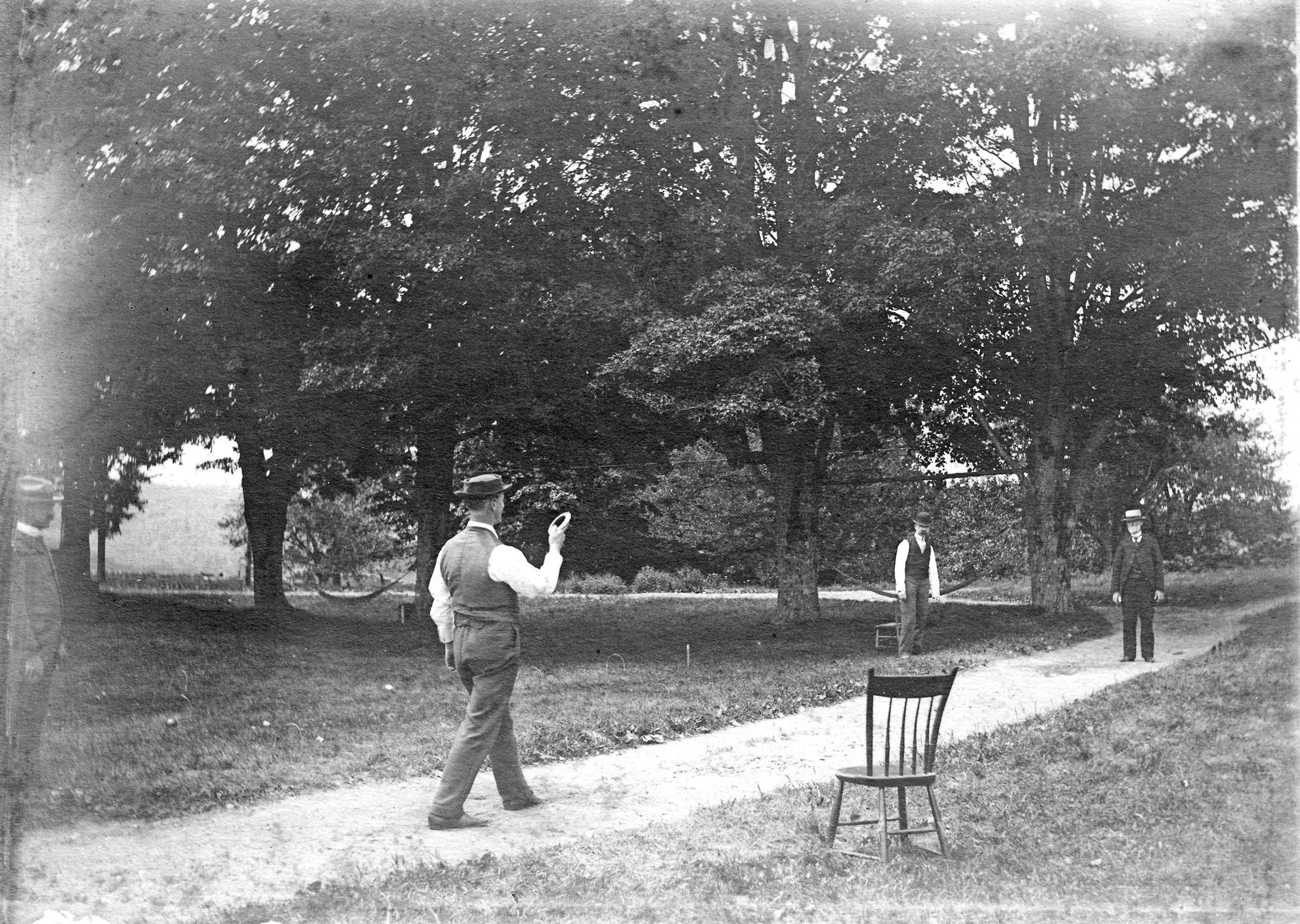
There are many photographs of people playing lawn sports on the property such as croquet.  What I find most interesting is the household chairs in the driveway.


The Wrights took great pride in the history of their property.  The family had owned it since Pardon Haynes built it and moved in.  You have to wonder if the oral history of the fort was passed down for a number of generations, whether it was a sort of common knowledge within the family when they named it Fort Pelham Farm.   The name has stuck with the property and probably always will so rather than being known as the old Wright place or the Alix place it will continue to be known as Fort Pelham Farm.

Winding Down


When I started this blog I thought I could at least contribute something on a weekly basis.  How wrong I was.  The summer arrived and with so many chores around the property this had to go on the back burner.   As of yesterday the garden is a memory.  I pulled everything except the carrots and rutabagas and will probably amend the soil and till it this coming weekend.  I was sad to see this garden go this year.  Some years are not as successful or beautiful.  This garden, for the most part, was a great one.  It was photographed often.  It yielded more produce than I even cared to preserve.  It was a place for the wildlife to leave clues to their existence but left me wondering weekly what had transpired in that patch while I was away or asleep.  Now I’m starting the plan for next spring – what to plant, where to plant it, how to lay it out so it will call me to photograph it once again.

The Reclamation Project

For the past five years we have been working to reclaim some of what was once pasture in the back of the house.  My father always referred to it as the back forty and the name has stuck.  The above photo is a panoramic taken last year at the end of burn season.  We have been picking a spot to clear and burn every winter and work towards that when there isn’t a lot of snow.

This photo is directed towards the back forty and was taken in 2007.  It was completely overgrown with ash, cherry and grapevines.  With the help of family and friends we have been working on restoring a view from the lawn.

In 2009 we achieved an opening and I was thrilled to sit in the adirondack chairs and get a glimpse of the back pasture.  We continued to clear and burn.  Finally in 2011 this was the view we had.

The project continues.  We have reached the stone wall to the south and also to the north although they need to be cleared of smaller trees and bittersweet, a project in itself, as well as freshening up the stonewalls where the stones have fallen to the ground.  At some point we would like to see Adams Mountain again as they once could.

View of Adams Mountain from the back forty taken about 1885.