The Reason I Started to Weave

Book Cover

Most of my family on both my mother’s and father’s sides immigrated to the United States in the late 1800’s, the majority of them went to work in woolen mills in various parts of New England.  This is fairly typical for immigrants of that era.  Their skills were learned on the job and they worked their way into different jobs in a particular type of manufacturing.

My father’s father, Elmer, worked in woolen mills his entire life.  I can’t say for sure what all of his jobs entailed but he is listed in the 1930 Census as a Loom Fixer.  He was a brilliant man and could fix anything, including machining any parts that he needed.

He left behind a number of books where he kept track of all sorts of things including loom set ups.  I had never woven a thing so when I looked at this particular book it didn’t make any sense other than to know that they were drafts and swatches of fabric that he had woven.  That’s pretty cool in itself.
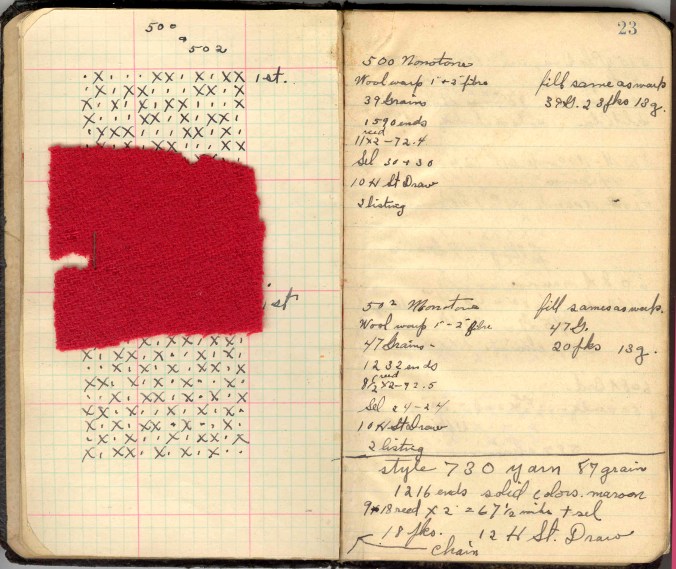
Weave Instructions (1)He had his own woolen mill in the late 50’s and early 60’s and I’m assuming these were some of the drafts for what he was weaving at the time.

Weave Instructions (3)Not ever having woven a thing I had no idea what he was talking about but felt like if I learned then I could be privy to his secret language, sort of get inside of his head.

Weave Instructions (4)A friend was moving last summer and posted on her Facebook page that she needed to get rid of her Harrisville loom and was anyone interested – I jumped on it.  When I did I was thinking about this book and my family heritage with weaving.  I googled weaving instructors for that particular loom and found Pam in Brimfield.  I brought the book into class the second week to find out if I would be able to read it at some point.  The mechanical looms are very different from the hand looms but what I’ve found is they are all the same really.  She assured me that I would be able to read his drafts but would also be able to weave them

I look at this book in a totally different way now.  I understand what he was saying and doing and it’s truly amazing.  He would write the drafts, set up the looms and then attach a swatch of what he had created in his mind.  Wow.

In the past year of weaving class I have learned the mechanics of dressing a loom and weaving structure (the basics).  I have learned that my brain works in a way where I can see from a draft what a weaving structure will look like.  I’ve learned that I inherited the ability to do this and understand it.  Now I can spend some time actually weaving some of the drafts that my Pampi wrote.  How cool it that?
Weaving Wednesday 7


130514 Weaving (1)

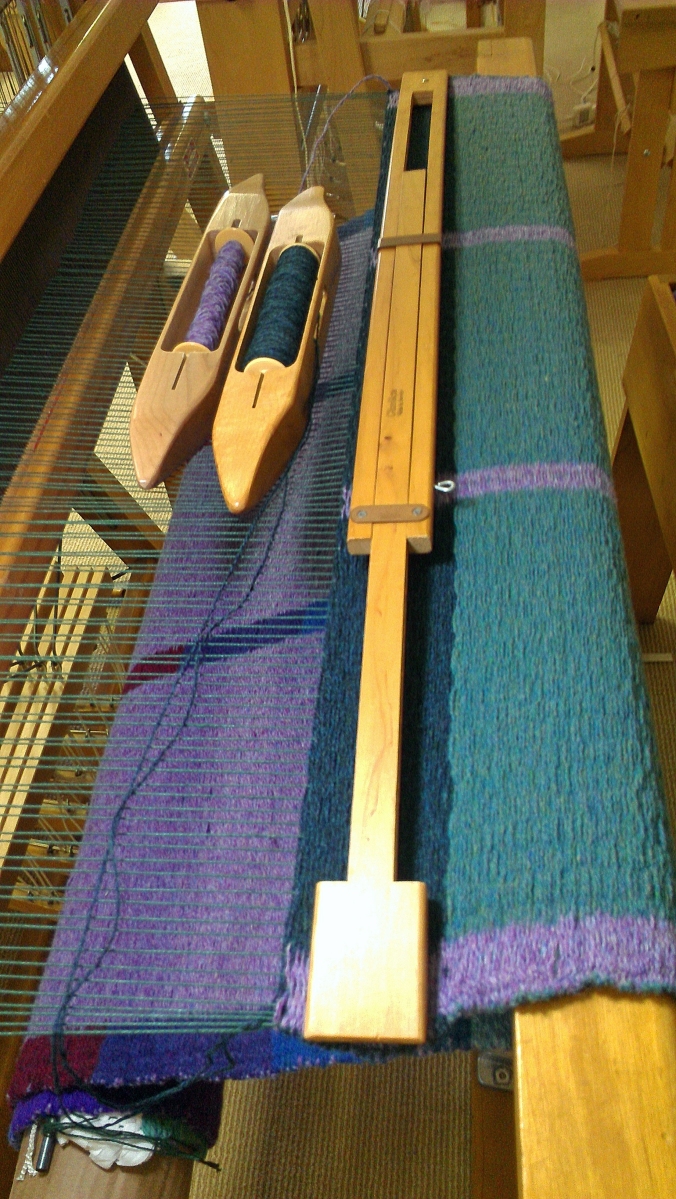
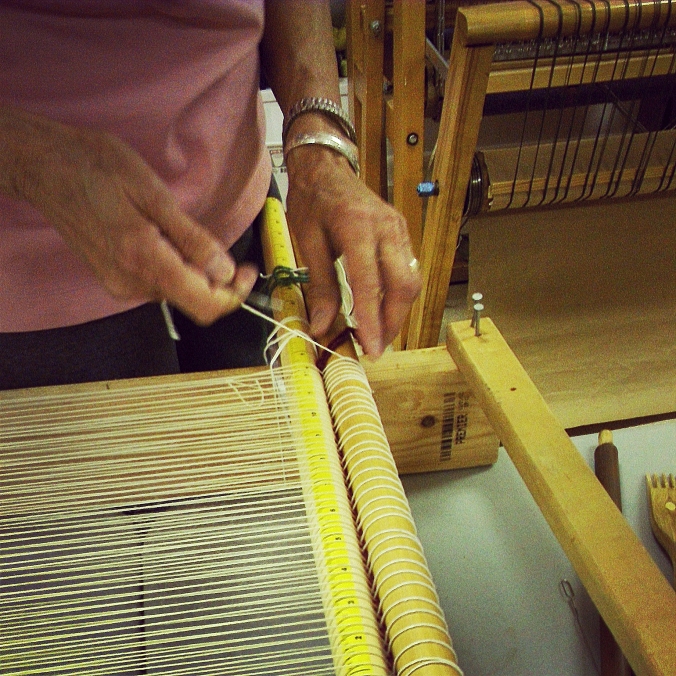
Pam, our instructor, lashing a warp for a Navajo rug.

I left early yesterday thinking that with an extra hour I would be able to finish threading it and possibly sley the reed.  Ahhhh, the best laid plans.  Last week when I started threading my warp I was on fire.  Everything went in order, no mistakes, perfection.  I only had time to thread the first half so with the extra time I figured this should be easy.  I threaded, rethreaded and threaded again the last half of that warp.  Three hours into it I had 25 to 30 threads left over at the end.  Count, count, count, rethread, count, count count, thread again, still wrong, ugh.  Sometimes your head is in the game, sometimes it’s not, last night it definitely was not.  I got there at 5:00 and by 8:30 I had the reed on ready to start that but really didn’t have enough time so it will be waiting for me next week.  Bummer.

When I first arrived at the studio I went around and took a few photographs of the other weaving projects going on.  It’s all fascinating to me and there is just so much you can do (although the just gives me weaving ADD).  Since my loom looks almost exactly the way it did last week I’ll share some of the other weaving – without description since I’m not sure of the proper terminology.

130514 Weaving (4)

I have my class on Tuesday evenings so there are only a couple of other women that I actually weave with.

130514 Weaving (3)

We do have weaving “theory” classes once a month where all of Pam’s students get together to learn about drafting, structure and color. Now I can put the names and projects with the faces.

130514 Weaving (2)

It has been an amazing experience playing with these women who are all at different places in their weaving education.

130514 Weaving (5)

All of the weavers that I have met are very generous people.  They are open, honest and giving.  It’s like going to therapy every week.  We are all around the same age with wildly diverse backgrounds but we come together to create beautiful things.  You see everyone’s tastes are so different in their color choices or even their projects.  Pam steers people in the direction of their capabilities and gives direction when needed.  She encourages each of us to work on our own so when we leave we can go home, warp our own looms and weave without her assistance. It’s nice to know that she’s only a phone call away though, I’m not all grown up yet.

130514 Weaving (6) The photo above is of a double weave rug (I know this much).  It is one of the most stunning things I have ever seen.  Makes me think a rug is in my future.


Weaving Wednesday 2

130305 Weaving


Last night I finished weaving my X’s and O’s after fixing a threading issue that was messing up the X’s.  With my OCD with perfection it HAD to be done!  I moved on to using 3 shuttles to do columns, two with complimentary colors and the cotton tabby.  It was a little confusing at first but once I got into a rhythm of what to do with the shuttles that weren’t being thrown it was fine.  I had some issues with my selvages but I think it was because I was concentrating on the pattern.  Too much was going on at the same time!

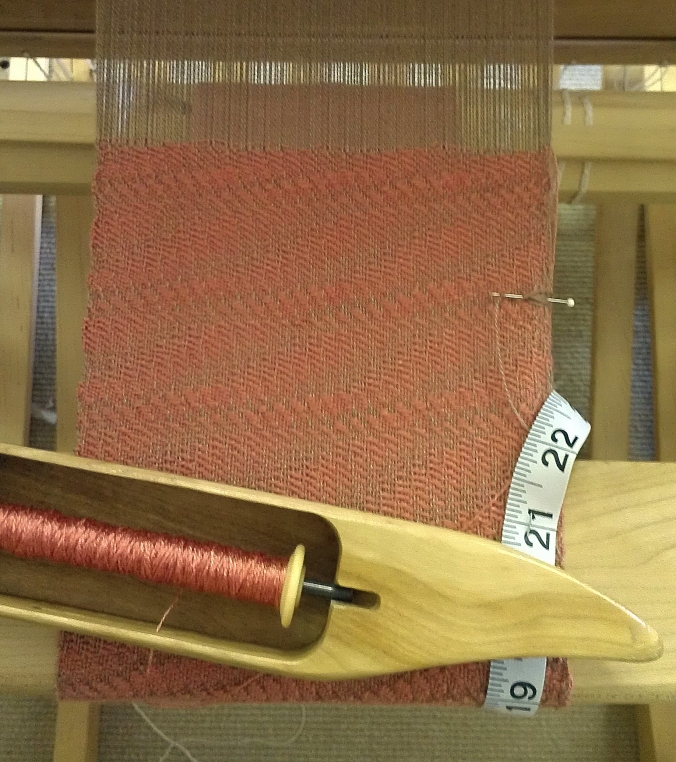
Not shown was a mistake I made that turned into the most wonderful tweed like pattern.  I only did it for about an inch when we realized I was reading the draft totally wrong.  Now I think I want to weave something with that mistake alone.

I finished the class with Atwater Bronson lace.  It’s very easy to treadle BUT I beat everything to death so the lace part didn’t actually show very well.  I’ll have to work on loosening up.  Pam said I won’t be weaving gauze any time soon.  Ha!

Weaving Wednesday 1

Weaving (1)


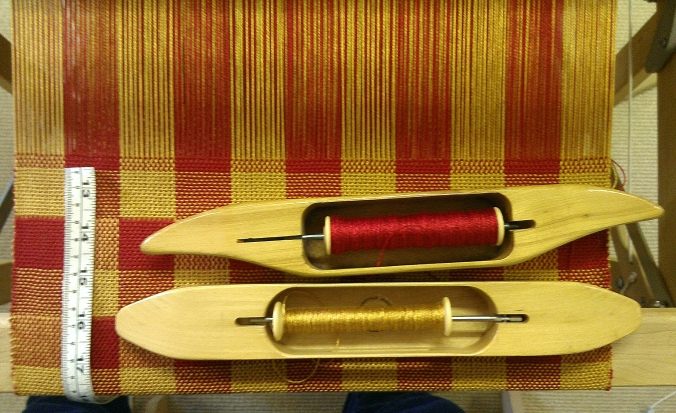
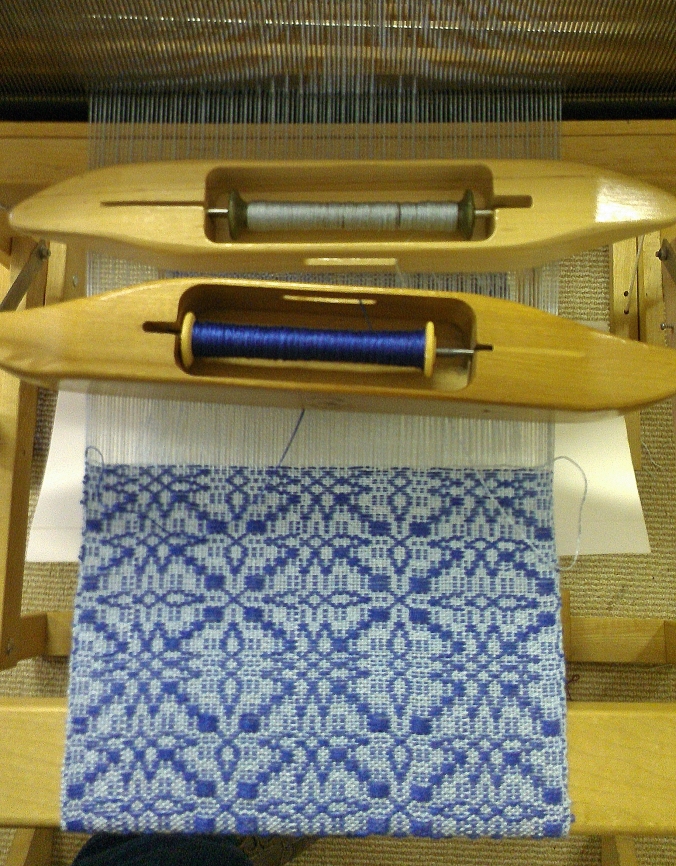
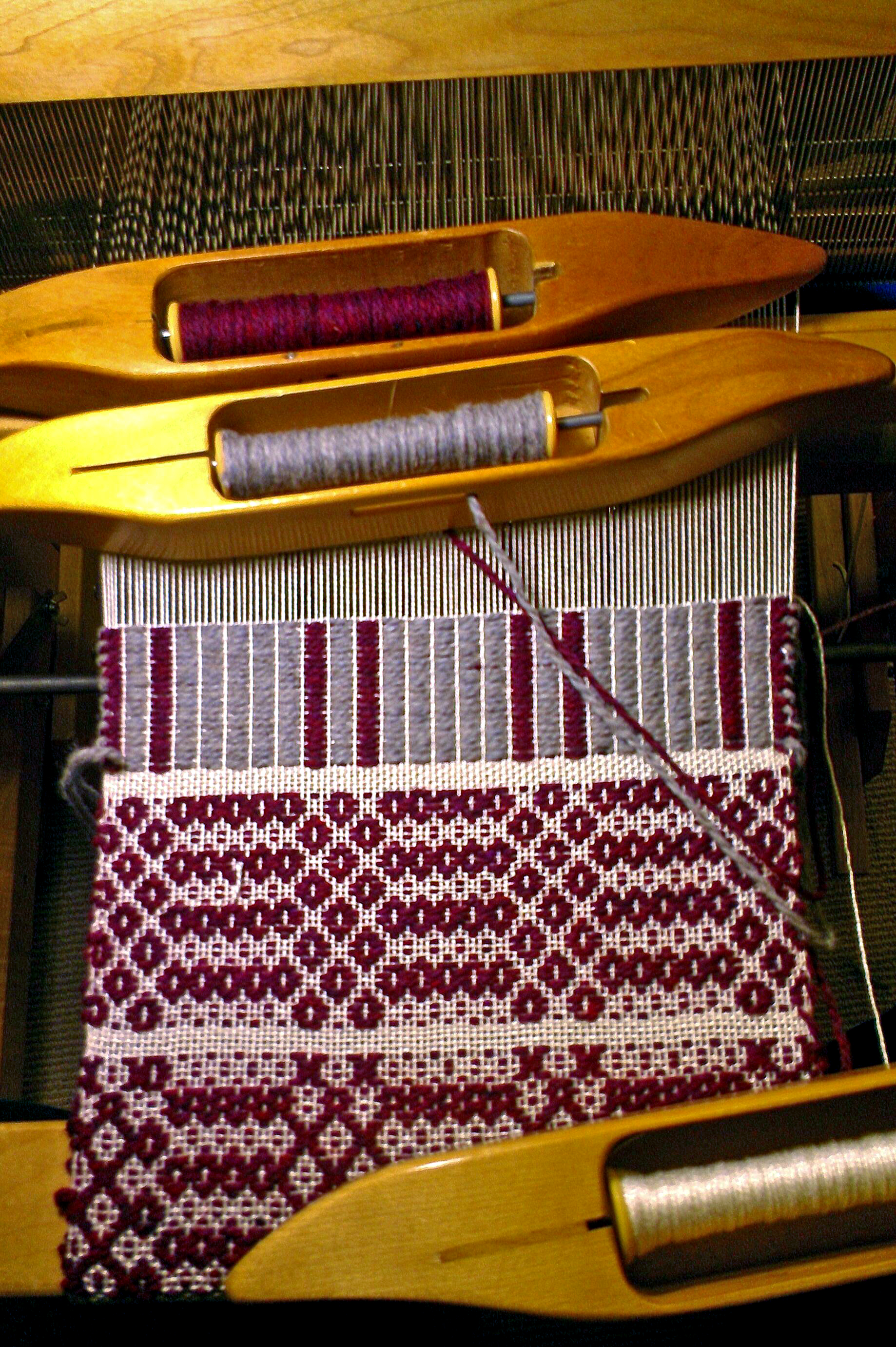
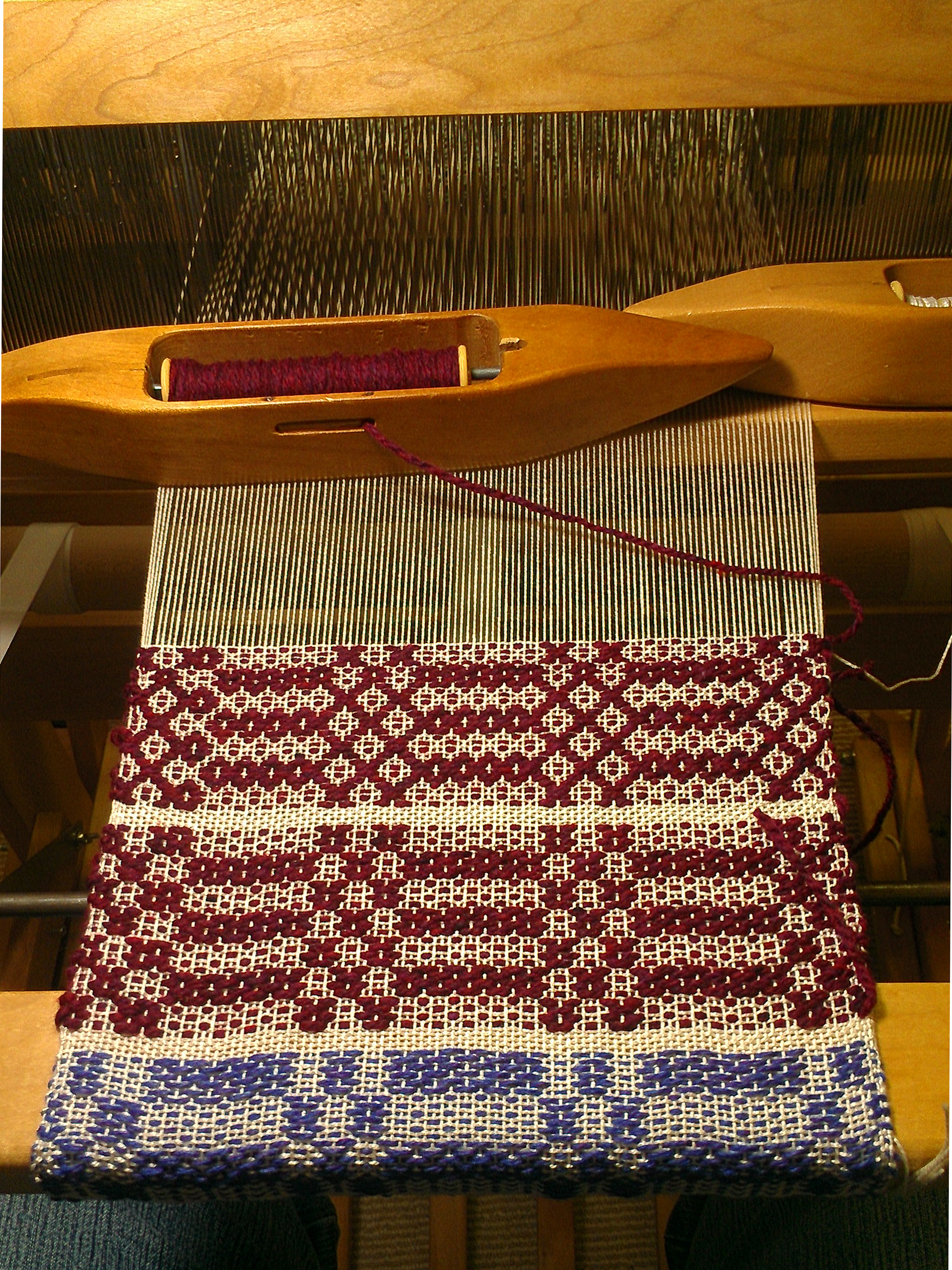
Last night I started weaving on the warp I had set up last week.  The pattern is called Summer and Winter and has probably as many variations as I can dream up.  I began with a blue wool yarn weft with the yarn about the same weight at the cotton warp.  It is woven with two shuttles, one with the wool, the other the same cotton as the warp.  This allows you to use the wool as the design element and the cotton holds it all together.  After weaving with the blue I switched to a worsted weight yarn with more dramatic results.  I think this is because the thicker yarn fills in over the cotton making the patterns much more visible.


Weaving (2)


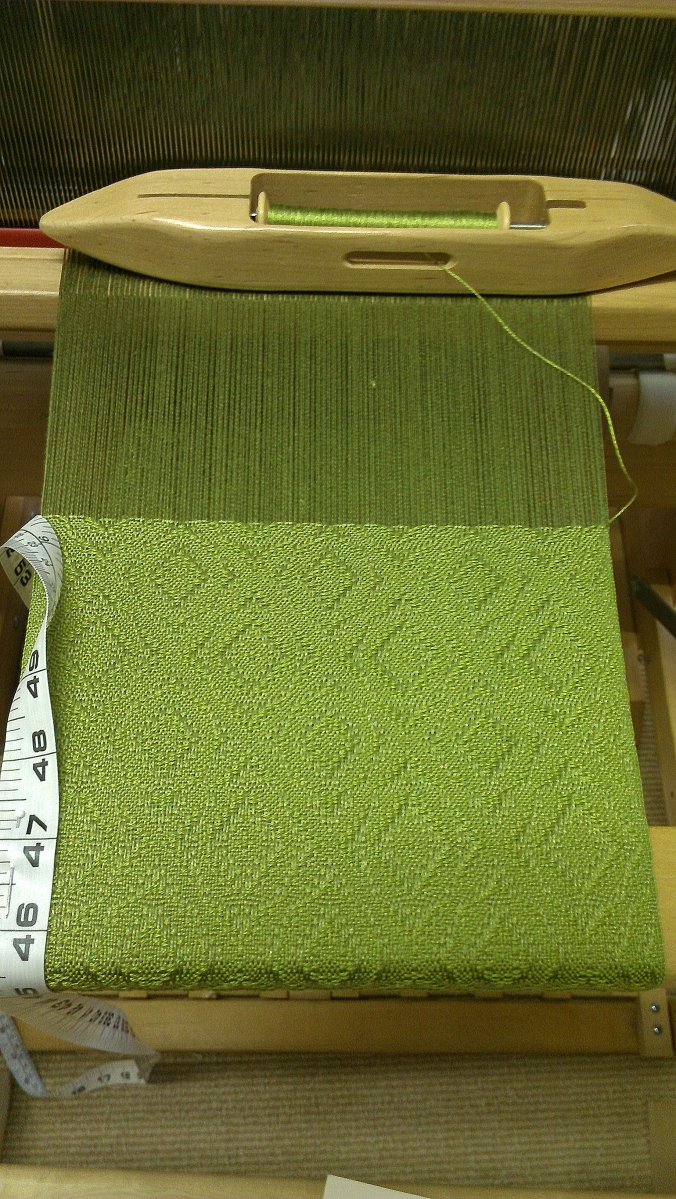
Of course it wasn’t until I got to this point that I realized my mistake in warping the loom.  I could have continued to weave the brick pattern (the first done in red) and would never have seen it.  Well, now, looking at the photograph, I can see it but once I got to the trellis type pattern it was blatantly obvious.


Weaving (3)


You can see how the diamonds aren’t connected on the left hand side.  This was caused by ONE thread being in the wrong harness.  Having a bit of an OCD with perfection all I could think was “damn, I’m going to have to look at that for another 2 1/2 yards!”.  My instructor, Pam Engberg, told me we could fix it and showed me how to tie a string heddle and moved my warp thread.  FIXED!

Weaving is one of those things that I’m sure I could do by using someone’s written instructions or using YouTube but when you get into trouble it’s a whole different story.  Pam has been weaving for many, many years and knows the tricks of the trade.  If I was by myself I would have continued weaving with it wrong (weeping all the way).

I think with any craft it is always good to take a class with someone who knows what they are doing.   A good instructor sees your strengths, understands your weaknesses and gives you the tools you need to work on your own.  Pam is teaching me the tricks of the trade.  She is excited about me learning to weave and I’m more than willing to learn it.  Win, win.

The Weaving Adventure Continues

IMAG0300


Over the holiday break I spent two days warping the loom that sits in the library at the house in Rowe.  I learned a lot.

I first went out to the wood shop and made myself a raddle and a thread cone holder.  It cost about $4 in materials, saved me about $70 more or less.

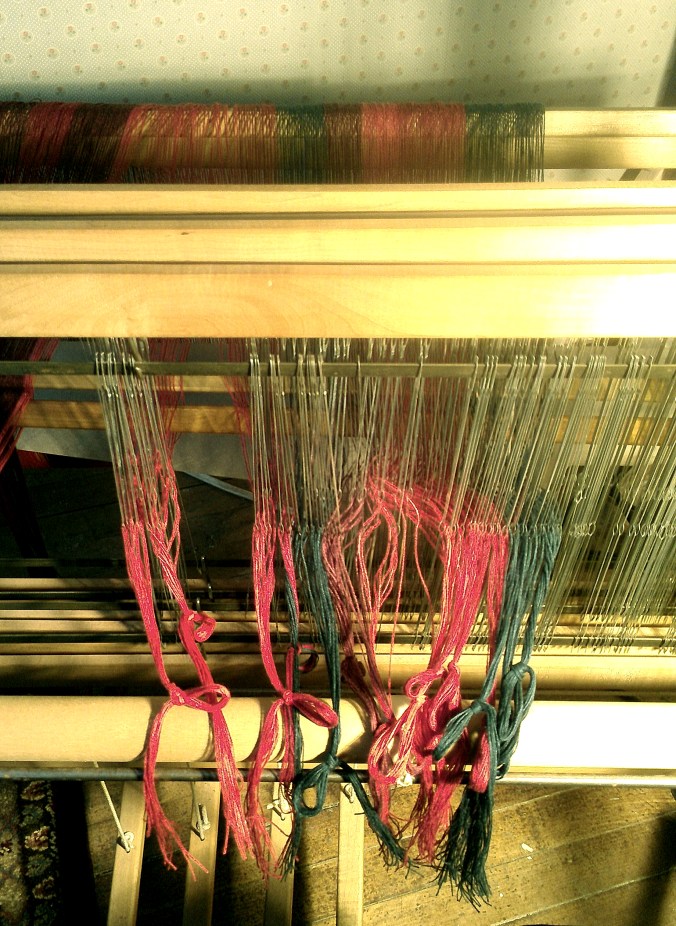
I wound a warp of various colors for the first time.  Everything went along beautifully until I slayed the reed and realized that the left side of the warp threads were a good 2 inches shorter than the right.  Uh oh.  I figured I would just see what it would do since I hadn’t used this loom before and figured if nothing else I’d find out what kind of issues it has (there are sure to be some right?).  After tying the warp to the front I opened one of the sheds to find that the tension on the left side was too loose and it barely opened.

This was a long warp so I’m thinking it may not have been beamed tight enough or  I wound it unevenly.  Honestly I think the the loom was not square as well as sitting on an extraordinarily crooked floor.  After looking at the problem and stepping back from the loom I could see that the front left corner was lower than the rest so the whole loom was twisted.  Hmmmmm.  I walked away.

I know I have to rewarp the loom.  I also have to replace the harness cables.  The ones on the loom now are leather, dried out and all different lengths, those will be ordered this week.  When they arrive I will replace them and rework the whole loom to make sure it is square.  Then I will move it into another room where the floor is more level and start over again.

I have to say that this is really one of my favorite parts of the whole weaving thing.  So many things can go wrong but it all has to do with the mechanics.  If I can get the machine to do what it’s supposed to do then the only problems I will have will be my own doing – miscount, tension, or a hundred other mistakes that I don’t know about yet.  This is quite the adventure.

The pain of the learning curve

121127 Warping Towels

Warping board with cotton warp.

A few months ago I bought a 36″ 4 harness Harrisville loom from a friend who was moving.  She posted it on Facebook asking if anyone was interested.  The second I saw it I said sure and the rest is history.

Let’s start by saying the only weaving I have ever done is a potholder.  I’m a good potholder maker, everything is neat and I work on design with color but it’s a potholder.  I come from a long line of weavers so my take on this was it’s probably genetic, I’ll find a teacher and run with it.  I found Firewatch Weavers on the internet and sent in my deposit.  I was thrilled to find someone that teaches on a Harrisville.  I took Pam’s first 6 week course and warped and wove a sampler.

Next project – cotton towels with a twill weave.  Cool I’m thinking.  She always has us do a worksheet to figure out the warp before we begin.  I understood what I was doing and I began winding my warp.  I had limited time at the studio that night so I left at 9:00 pm and decided to return in a couple of days to finish winding.  Pam told me I’d probably have to wind it in two sections because I wouldn’t have enough room on the warping board for the whole thing.  When I returned I took off the first half of the warp and began winding the second half.  I was almost finished when she asked me how wide my towels were.  14 inches I replied and saw this look on her face, then a smile.  I’d warped enough to do the project twice!  Ugh, is what I initially thought but then she said well now you can warp your loom in Rowe and weave it at the same time!

Lesson learned.  Warping can be pretty tedious although it is probably the most important part of weaving, at least from a design stand point.  There are 12 other weavers in the studio at any given time, all of which are at different skill levels.  One of my favorite things is going from loom to loom discussing each project and then the ways that many of them have screwed up their warp and ultimately were in a bind when they started weaving.  Lessons learned, just not necessarily on my loom.

In the coming weeks I’ll be talking about setting up the loom in the library in Rowe and the adventures that I am sure are going to follow.  Some include working in the wood shop to create tools to help me with the weaving.  This should be interesting.