Oh What a Beautiful Morning

130630 Morning Mist


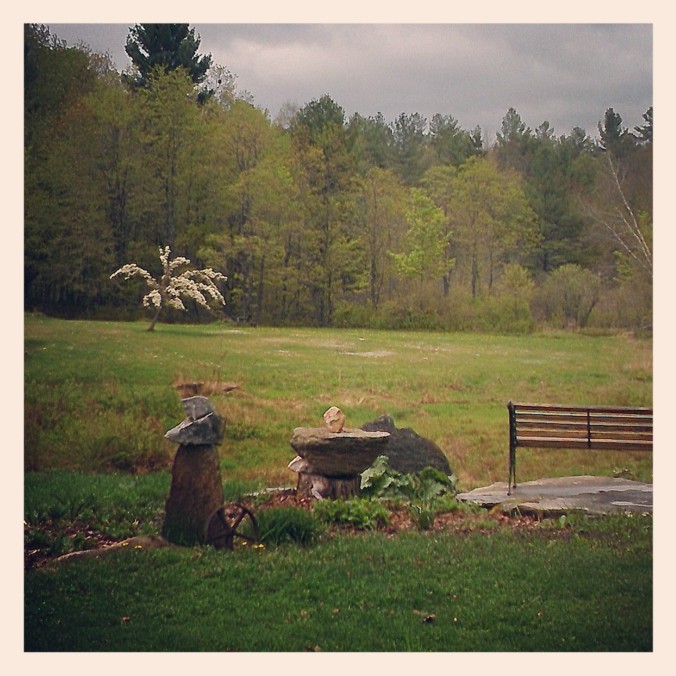
There is nothing better than getting up just before the sun peaks over the mountains to the East.  The mist rises off of the back field and the sunlight begins to shine through it sending it’s rays to the ground.  This is the first day of our staycation here this summer.  Quiet, drinking my morning coffee in the field with the birds, once again connected with the earth and nature around me.

The dew is thick this morning and the one thing that keeps me from being relaxed is as the sun casts its light on the dew covered plants it accentuated every weed in the garden.  So after that quiet little interlude, soaking it all in, all I could think about was weeding the garden.  Sigh.

Chive Blossom Vinegar

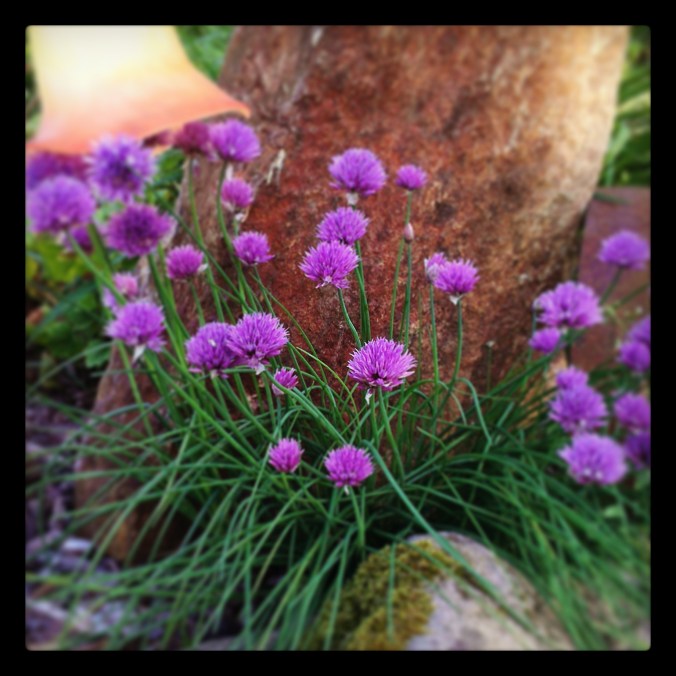
130616 Chives in bloomA couple of years ago I read about making chive blossom vinegar.  This has to be the easiest infused vinegar to make and one of the prettiest.

The chives are in full bloom right now.  When they are take a quart canning jar out to your garden and pick the blossoms until the jar is 1/3 to 1/2 filled.  Fill the jar to the top with white vinegar, cover and set on the counter for about 2 weeks.  Strain it through cheesecloth into a clean container.  There you have it!   No processing needed.

This is a beautiful, bright pink vinegar with a bright chive taste – perfect for salad dressings.  My favorite thing to do is make a refrigerator pickle with sliced fresh cucumber, topped with this vinegar, salt and pepper.  Let it sit for a couple of hours and you have a fresh, tasty pickle with a mild overtone of onion.  Wonderful.


Fruit

130615 BlueberriesThe rain has stopped – for now.  In doing my morning walk about I noticed how well the fruit on the property was doing.  The blueberry bushes are loaded this year, last year I didn’t get a single berry.  It warmed up to abnormal temperatures in February 1012.  A week or more of 70’s and 80’s fooled every early flowering plant, tree and shrub into thinking spring had arrived early.  The temperature then dropped to below freezing (where it should be that time of year) and froze every blossom on the fruiting trees and shrubs.  It also completely messed up our sugaring season.  In 2011 we made well over 100 gallons of maple syrup, in 2012 maybe 30. Our pear tree had 3 pears, the deer ate two and my sister picked the last one.

Losing your entire fruit crop is distressing in many ways.  You’ve already made plans for what you are going to put up based on previous years and suddenly you realize there will not be any fruit of any kind.  This year the pear tree is loaded once again and I’m making plans for what to do with the hundreds that will be available (barring any extreme weather event from now until frost).  I often wonder about people who plant 5 or 6 of a kind of fruit tree.  This one tree, in a good year, produces enough for a few families to eat fresh and preserve. I find that at times it has really stressed me out because I feel like I’m wasting good food by not putting more up but honestly you can only do so much.  The deer eat the drops and the ones hanging from the lower branches. I try to give them away.

I have to say that one of the favorite games for the dogs involves that pear tree.  When the fruit starts to drop onto the ground we go down to the tree and I toss the pears as far as I can in rapid succession in different directions.  Buddy will chase a couple, then settle down to eat one.  Sophie will run after one, tag it and run back.  Chester will fetch them all day long, every so often taking a bite out of it but always bringing it back and dropping it at my feet.  The only problem is he likes the game so much that he continually goes out in the field and brings pears up to the driveway and the lawn.  A lot of fun when you’re mowing the grass.

130615 PearFruit is always a long term endeavor.  I planted a row of raspberry plants that Carmen had given me last year.  I got a couple of berries in July (I probably would have picked more but caught Chester picking them, apparently he finds them tasty as well).  This year the patch is twice as large – raspberries propagate readily sending shoots up all over the place once the plants get going.  I will probably have enough berries for a couple of pies and maybe a small batch of jam.  I transplanted more canes this spring doubling the number I had.  I’m looking forward to a crop large enough to put up for the winter.  Now that I can see the potential for this patch of fruit I’m happy that I did it.

Growing these types of long term crops can be a difficult decision to make.  You always have to create a new bed for them and put it in a place that you know will be dedicated to that fruit.  Trees are the same way and even longer term considering how slowly they grow and the years it can take before they bear fruit.  Once that tree is planted it has to stay there, that’s a commitment.  I planted a bed of asparagus this year at the end of my vegetable garden knowing full well that it will effect how I till for years to come.  I will not be able to eat anything from this bed for another two years but once it’s going I could potentially have a healthy asparagus crop for another thirty.  I’ll take that and leave it to my kids.


When the Weather is Bad

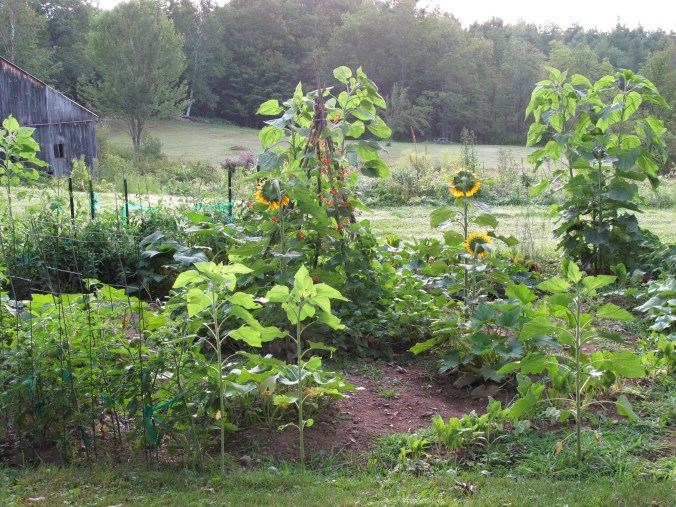
100808 (39)

Garden in August 2009


A couple of weeks ago I was reading the blogs of young farmers across Ohio, New York and Vermont lamenting the loss of their crops due to an unexpected frost.  They had started all of their long growth veggie plants indoors, nurtured them, fussed over them, dreamed about their potential.  The weather warmed a couple of weeks early and in the eagerness that befalls us all when we think spring is here they transplanted everything into their newly tilled beds.  They were watered in, possibly staked up, fussed over some more.  The following week we had 3 days of below freezing weather – all of their sprouts were lost.  That’s a true hit for a small farmer.  You try to do everything right, avoid starts coming in from some other state or parts unknown.  You want to know how they were cared for, no one will love your little plants the way you do.

A similar thing is happening to me right now.  We’ve had very rainy, cold weather for the past week and a half.  Yes, right after I transplanted my starts and put my seeds in the ground.  I waited, I always do.  The official Memorial Day weekend this year fell on May 25 and 26 this year.  Too early to plant I said to myself, I’ve been burned before and the soil temp wasn’t high enough to germinate seeds.  I waited another week.  The weather wasn’t great but between a couple of rainy afternoons I got everything into the ground.  The following week was hot as blazes, it felt like late July.  Things were looking good.  The waiting is the most difficult for me.

It turned fairly cool a little over a week ago and it’s been raining a lot.  The sump for the cellar was running non stop last night as it does when the water table is extremely high – not a good sign.  I woke up this morning to a temperature of 48 degrees.  The rain had stopped right before dawn and I walked the garden with the dogs.  Beans and corn are up for the most part, rhutabagas as well.  Radishes, onions and all of the tomatoes look okay for now.  No potatoes yet which isn’t what I’d like to see and the Long Pie Pumpkins will probably have to be replanted.  I take heart in the fact that it’s still early enough to get a harvest from those things I have to replant but I’m also just waiting for signs of blight on my tomatoes, they’d rather have it sunny and warm you understand.

If I had to survive on the things I grow myself I would be scared right now.  There are so many crop issues that this weather has effected.  Things are slow to grow.  The fields are so wet that haying will have to wait (with a little prayer that it won’t rain like this for a while). Some times it’s difficult to put yourself into the shoes of your ancestors, so many of mine were farmers.  How must they have felt has they stood in the middle of their corn field with the plants 2 to 3 inches tall and fully a third of said field under water?  We take for granted that someone else is growing our food for us, they are the ones taking the risks.  We complain if the price of things go up or if fresh veggies are more difficult to come by but think about if food production was your whole life.

I’m convinced the day will come when a very large percentage of what I eat I will have to grow myself or in cooperation with my neighbors.  I garden because I love it but I also know that you can’t just decide one year that you are going to grow your own food.  In New England (and probably everywhere else) each growing season is different.  Every year I learn something new because I have to deal with some problem from the weather or pests.  You learn, you grow, you change.  The variety of food I grow is different from what I grew 10 years ago.  Part of that is that my garden has expanded over the years, part of it is there are things that just don’t do well in my particular spot.  Each year I try something new to see how it goes.  There are winners and losers.  I’m hoping that things warm up and dry out a little now or we will see what really survives in an adverse weather year. I’m also praying for a little more patience, things have a way of working out.

Beginning in Earnest

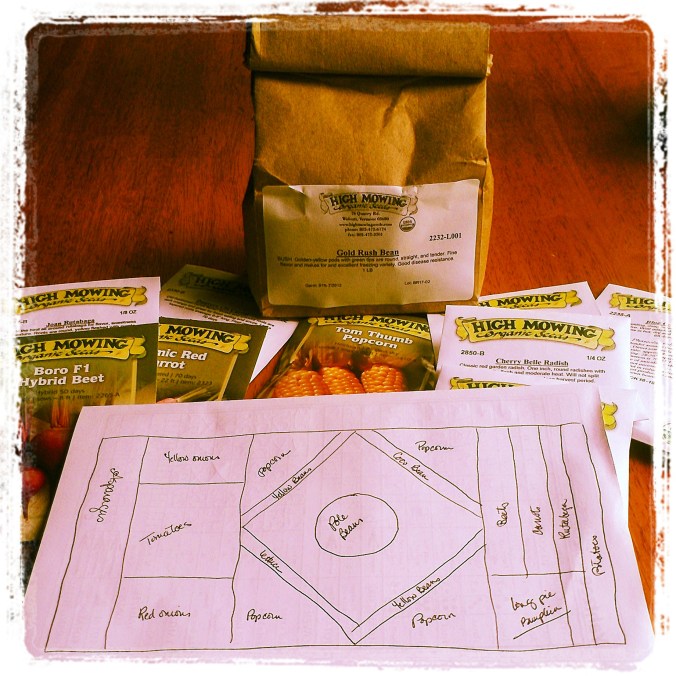
130526 (2) Garden PlanYesterday in the cold, rainy, windy weather I went through my seeds and actually drew up the garden plan.  It had been in my head for  a while just finally put pen to paper.  Today I plant the crowns and bulbs, put up the bean teepee and get out the seed potatoes.  Last night it was cold by any standard but the forecast for the rest of the week is warm and sunny.  By the 31st I should be able to put my seeds in the ground if the forecast holds true.  All of my seed comes from High Mowing Seeds in Vermont.  They are organic, non-GMO and many are open pollinated.  Honestly the best seed I have ever used.

I had taken all of my annuals in pots into the shed on Friday night, this morning I will go see how my lonely little eggplant fared. I will be mixing beans on the poles this year, I’ve planted just a green bean in the past couple of years but I really have missed the scarlet runners – and I’m assuming so have the birds.  I will also plant sunflowers in the corners with the popcorn.  I’m kind of taking for granted the popcorn will end up being fodder for raccoons but you never know.  This variety is Tom Thumb and only grows to a maximum height of 3 feet, I’m more than a little excited about this experiment.

We have a guy in Enfield we refer to as the flower gypsy.  He’s a wholesaler who has a van and goes from shop to shop selling cut flowers – this time of year annual pots and vegetables.  He comes around every other week or so with what he figures will sell for the season.  During the winter it’s always long stem roses from Ecuador.  Easter it’s lilies, cut flowers for Thanksgiving and Christmas.  I was pleasantly surprised when I walked into the shop the other day to four pepper plants and four tomatoes.  Bill always buys me flowers but apparently he’s been listening and bought food.  Hehehe, excellent, my plan is working, one person at a time.

Little Patch of Tilled Earth

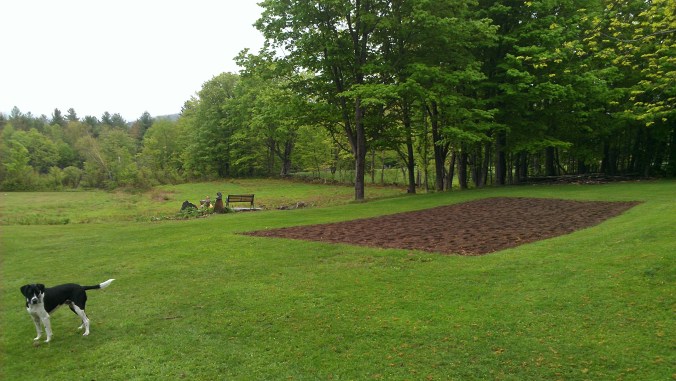
130519 Tilled GardenThis past weekend was a rather productive one considering it rained most of Sunday.  I made my way to the Shelburne Farm and Garden early on Saturday morning picking up a few plants, mostly for the newer perennial garden.  I completely weeded out the raspberries and the garlic patches plus planting all of my new plants by noon.  The dock growing in every bed is beginning to get to me since I have to use a shovel to get each one out.  The roots are all about a foot long now.  Dandelions everywhere, but when there are so many of them it’s rather pretty.

Cleomes were planted in the perennial bed, my all time favorite annual.  The garden center had some nice ones so I planted them in with the Echinacea .  I was disappointed with things not coming up but I think I’ve just been impatient.  Everything in the perennial beds is up as I remembered it being planted and it’s beginning to fill in.  I have been checking for the jack-in-a-pulpits on the north side of the house for a couple of weeks now and hadn’t seen them until yesterday.  They have been there the entire time we’ve been at the house so I would be disappointed if they were gone.

I bought an eggplant because I had never even seen one grown before last summer.  It’s been planted in a flower bed.  I will be putting asparagus into the north end of the vegetable garden this year, probably planting it on Wednesday.  I either had to plant it there or start an entirely new bed.  I couldn’t figure out where to put a new bed and figured committing space in the garden for the asparagus was worthwhile (it’s a 20 year commitment).  I’ll just have to till the rest of the garden with that in mind.

I tilled the garden on Sunday morning in between a couple of showers and swarms of black flies.  I had to get it done.  I also did a little soil test to see where the ph was and was pleased to see it was in a tolerable range.  I’d been worried that I was trying to grow plants that were just too unhappy with the soil conditions but it would appear that things are much better than I had thought.  I’ll hit it with some composted manure before I plant and continue rotating my plants every year.  Rotation works well for me because I bore so easily, each year feels like a new garden (well it is but I try to make the layout completely different).  Last year I had mostly rows going east/west, this year I will probably have more of a potager type.  The new, experimental crops will be a dwarf popcorn and some purple string beans.  For pole beans this year I will be interspersing Scarlet Runners with Kentucky Wonder I think.  I love the flowers and so do the birds, bees and hummingbird moths. Sharing my garden with these creatures is really what it’s all about for me.  Of course ask me again right after the raccoons destroy my corn.  Still unsure if I will do teepees for the pole beans or do a long trellis like I did a few years ago.  I will have to see what kind of saplings I can find in the woods.

The only things that will planted in the next week or so will be the asparagus, potatoes and onions.  Everything else will wait until the weekend of June 1st.  I’m always so over-anxious to get things into the ground I often put seeds in earth that is just too cold.  One more week won’t make that much of a difference.  I will be starting basil and nasturtiums in pots to scatter around the gardens.  I usually plant the nasturtiums in the garden but have found that they are difficult to weed around as they get going and they look great cascading over the sides of pedestal pots.

The photograph really makes my garden look rather small, in reality it is about 20′ x 50′, so it’s a pretty good size.  I haven’t put up the fence posts yet for my caution tape fence.  Chester spent a good deal of time yesterday in that fine tilled soil – he loves it.  You can imagine what he looked like after rolling around in it while it was raining.  And once again he has photobombed my pictures – he sincerely thinks he should be in every shot.


Food Rant Friday

Growing Food in Protest


Okay, so there are a few friends and relatives that know how pissed off I get when yet another article crosses my path about Monsanto and their GMO’s.  This week was the motherload in reading about various lawsuits that Monsanto has brought against everyone in the world from the small farmer to the state of VT.  Apparently the money stream is so important to them they are willing to take on any state in the union that would try to label food as containing GMO products.  Hmmmm, doesn’t it make you wonder what they are trying to hide?  I believe in informed consent.

There are now apps available to help you boycott all kinds of products as you peruse the groceries in the store, just scan the barcodes and voila you know what subsidiary that food is coming from and can make your choices with a little more knowledge.  I’m thinking that’s all well and good if what you are eating is processed but it’s really not going to help you in the produce section.   I read today that one of the country’s leading suppliers of French fries is asking the federal government to approve genetically modified potatoes.  This is to prevent those unsightly brown spots.  Really?

You know that lawn that you hate mowing every week?  Why not use part of it to put in a raised bed and plant some tomatoes there she goes talking about those tomatoes again?  Put a few potatoes in your little plot or grow a few carrots to eat right out of the garden.  I promise you the seeds that you grow will surprise and delight you. You will have such a feeling of accomplishment and be astonished at the money you save over the summer on some of your favorite things.  It’s also FUN.

I baked a batch of cookies the other day, shared them with sister Sue.  They are a delicious soft molasses cookie encrusted with course grain sugar, crunchy on the outside, soft and chewy in the middle.  Spicy and delicious they are the ultimate comfort food for me.  Then I started to think about the ingredient list – what’s gmo and what’s not.  Yeah, I know, but I’m always thinking about where my food comes from or what’s in it.  That doesn’t mean I don’t eat what’s put in front of me but I’m always aware – so is my sister.  After she ate those cookies with me and brought some home I texted her about all the potentially bad things that were in them.  Today in the interest of science and my guilty conscience I decided to actually look up what went into them.  I was pleased to find out that the things that were a little sketchy for me were all within my tolerance level for food weirdness.  So I’d have to say that if you are going to eat cookies bake your own and source your ingredients.  Now I can email Sue and tell her that those treats were really much more okay than I had led her to believe (and maybe she’ll stop sending me all that email about Monsanto).


Gardens

130515 Rhubarb


The first edible plant to arrive in my garden is rhubarb.  We eagerly look forward to it thinking about pies all winter long.  I have found no really effective way to preserve rhubarb that allows me to bake with it in the off season so we enjoy as much as we can while we can.

This particular rhubarb came from Bill’s grandfather’s property.  After he died and we were cleaning out the house for sale I walked the yard to see if there was anything I could transplant.  His back yard was very shaded and there was a very anemic patch of rhubarb in the back corner of the garage.  I dug it up and brought it to Rowe.  I planted it in front of a huge rock – it faces west.  The plants are shaded until noon during the growing season and I’ve found that really works well, it keeps it from bolting early in the season.  Last year I made a rhubarb pie in September and it was awesome.  I always thought if you didn’t get it in the spring that was it.

Being able to go out and pick something edible this time of year is a blessing.  Gives you hope for the rest of the season even if you haven’t planted anything yet.  I have garlic that looks amazing this year but I know I didn’t plant enough.  I will be tilling the garden this weekend barring any bad weather. I will set it up in anticipation of the ground warming to a temperature where I can plant most of my vegetables.  We had three nights below freezing this past week so I make it a rule to never plant before Memorial Day.

I’ve had a vegetable garden for about 8 years now in varying sizes and layouts.  I’m getting a grip on what grows and what will not and have had gardens through summers dry and hot, cool and rainy.  I think everyone should have a garden where they can grow something of their own to eat.  Our healthy choices are being taken away from us at a breathless pace.  I don’t believe if you go into a grocery store right now that you can have any clue where your food comes from or what goes into it.  You are being lied to on a daily basis about what’s organic or natural.  I figure if it says that on a package than it’s probably not.  Start using your farmers gardens.  They are springing up everywhere this time of year.  There may not be a lot of variety but soon there will be.  You’ll know that your veggies and herbs haven’t spent days in a truck coming to you from parts unknown.

The other thing I would add is if you plan on ever growing any of your food now is the time to start.  Gardens are slow motion works in progress, they can take years.  What works one year may not the next but those experiences are what help you to be a better gardener.  So many people I talk to think they can just put one in one year and it’ll be fine so they wait until they think they “really” need it.  Don’t wait, do it now, even if it’s just pots of tomatoes and basil.

Pear Blossoms

IMG_20130511_104220I wait eagerly for this each year.  The pear tree blossoming in the back forty.  It is always so beautiful, this year more so because I finally got down there to prune it.  Bill and I drove the tractor down next to the tree and took turns lifting each other in the bucket at different angles to cut off the suckers.  This tree has never been pruned and was rather overrun.  I used the lopping shears and he used his smallest chain saw.  It was more than a little scary being 15+ feet off of the ground and moving into a tree.  I think Bill’s ride was probably a little scarier since I don’t drive the tractor that often.  My ride was fairly smooth backwards and forwards, up and down.  Bill’s on the other hand . . . let’s just say next time he’ll probably opt for a ladder.  At Old Sturbridge Village they always said to prune your fruit trees so a cat tossed into it wouldn’t hit any branches.  Fruit trees like a lot of air.  With any luck we will have more than the one pear we got last year.  The spring has been more “normal” this year with a more gradual warmup so the blossoms didn’t come out too early.  As long as we get some pollinators out there we should be okay.

The patches of what looks like white in the field are bluets.  We always put off mowing the field until these have gone by, the patches get bigger every year.  They are like clouds in the grass.

It’s a drizzly, rainy day today but everything is looking wonderfully green and lush.  Something about it just soothes the soul after such a long, cold winter.

The Frustration of Food

ChickensToday’s level of farming ignorance is unprecedented in history—including all time and all cultures. Never have so many people in a civilization been able to be this far removed from their food umbilical. 

Joel Salatin

An acquaintance of mine, Jenna Woginrich of Cold Antler Farm just received her order of 45 baby chicks today and posted part of an article written by Joel Salatin in response to those who would criticize the practice of sending chicks through the mail.  Joel has the ability to explain in very simple terms why it is possible to have chicks comfortably make the trip from his farm to your house and remain perfectly healthy.  He also wrote this article out of frustration and I’m sure that anyone that raises animals for food can appreciate that but I think everyone needs to read the article.   The article is called  Rebel With a Cause: Anthropomorphism Against Farms, take a few minutes to read it, maybe read it to your kids, you will all learn something.

I grew up when most of our meat was grown ourselves or my father shot in the woods.  Sounds backwards and like I am some kind of hick doesn’t it?  I think something is lost when you don’t make an effort to know where your food comes from.  I believe you have to see their faces, understand what they are and what they give to you, sustenance.  I believe you need to know the kinds of lives that these animals have led and what kind of deaths that they have had in order to make peace with the fact that you are an omnivore and flesh is part of your diet.  Factory farming is farming at its worst, the only thing this is about is the almighty dollar, produce as much as you can as cheaply as possible.  It’s all about volume.

The frightening part to me is now everything you can buy in a grocery store comes from some sort of high volume farming situation.  If you want to know what is in your food you need to seek out the farmers of every single ingredient, visit their farms if possible and buy it directly from them.  I am fortunate to live in an area where there are many farmers of various kinds.  There is a small, family run dairy right down the street from my house in Enfield.  Smyth’s Trinity Farm takes dairy farming to a new (old) level in my mind.  I go there to pick up my dairy products and see all of the girls either in the pasture or in the stanchions in a very clean barn chewing their cuds and seeming very content.  All of their products are processed right there.  Once you start drinking and cooking with their milk, half and half and cream you will never go back to what passes as milk in the grocery store, you realize that you are being lied to about what they are selling you – it looks like milk but it doesn’t taste like milk.

Maybe that’s the problem, we’ve been lied to for so long that we now see what passes for food and something good and wholesome because it says so on the box.  We’ve lost our way, we really don’t know what is good and what is crap.  The gap seems to grow wider everyday.  If you’re reading this you could maybe Google GMO corn, or Monsanto, or the difference between wheat 20 years ago and now.  I can promise you it’s not pleasant reading, any of it, but it pays to educate yourself, you need to know what’s happening to us because of the profitability of big Ag.

Someone that reads my blog commented on what I really eat and if I was somewhat of a hypocrite.  In a word, yes.  I think we all are complicit in the problem with factory farming on every level.  I cook at home a lot of the time from scratch but even those recipes handed down for generations use ingredients that are now questionable.  It would require me to do a LOT of research to make some of my favorite meals from total scratch and I have not figured out how to replace American Cheese . . . sigh.  So I may not always cook as fresh and local as I want to for every meal but you can be assured that I think about and calculate what is going into it.  Then I make a decision about how bad I want that meal and at least know (and try to justify) what I’m ingesting.  Sometimes that’s the best you can do.