Weaving Wednesday 10

130616 Orange Peel ScarfI finished the cotton towels I was weaving in Rowe on Saturday and was desperate to warp a new project. I decided on an overshot scarf in the Orange Peel pattern.  The warp is fairly short and only has 146 ends.  I was not ready to do a huge warp for another throw just yet so I made a little trip to Metaphor Yarns in Shelburne. They have some really beautiful yarn – really beautiful.  I was looking at a draft before I left that used tencel as the warp with sock yarn as the weft.  After poking around the store I found some fingering weight alpaca blend and figured I would change the sett if I had to (pretending I actually understand what I’m doing well enough to do that).  The warp color is called potting soil and it’s lovely.  I chose a red alpaca worsted for the weft.

Sunday morning I was on fire – I warped that loom in record time and am proud to say not one mistake – woohoo!  I like the way this overshot pattern is going.  The scarf will be 70″ in length with a twisted fringe on either end (since I know how to do that now).  The fabric is fine and will have a nice drape.  Best of all , it will be warm!

This is when I truly am thankful for the lessons learned this past year in my weaving class at Firewatch Weavers.  I am able to plan out my project. I know how much fiber and of what weight I will need to create what I have envisioned in my head.  I know how to read the draft no matter how it’s written because truth be told not all drafts are created equal.

It is amazing to me that I can follow these steps – by myself – and have results like this.  The problem I have now is this is what I spend my days dreaming about – sitting at that loom and throwing a shuttle (or two).


Chive Blossom Vinegar

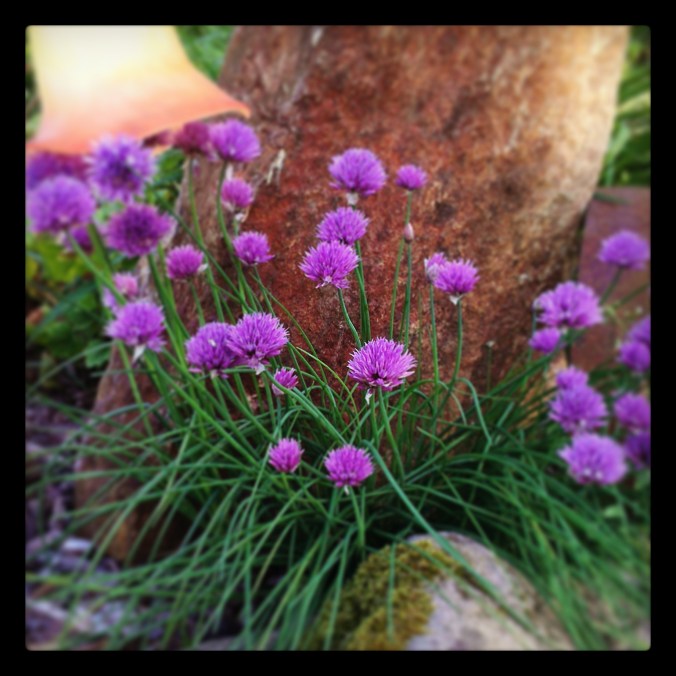
130616 Chives in bloomA couple of years ago I read about making chive blossom vinegar.  This has to be the easiest infused vinegar to make and one of the prettiest.

The chives are in full bloom right now.  When they are take a quart canning jar out to your garden and pick the blossoms until the jar is 1/3 to 1/2 filled.  Fill the jar to the top with white vinegar, cover and set on the counter for about 2 weeks.  Strain it through cheesecloth into a clean container.  There you have it!   No processing needed.

This is a beautiful, bright pink vinegar with a bright chive taste – perfect for salad dressings.  My favorite thing to do is make a refrigerator pickle with sliced fresh cucumber, topped with this vinegar, salt and pepper.  Let it sit for a couple of hours and you have a fresh, tasty pickle with a mild overtone of onion.  Wonderful.


Fruit

130615 BlueberriesThe rain has stopped – for now.  In doing my morning walk about I noticed how well the fruit on the property was doing.  The blueberry bushes are loaded this year, last year I didn’t get a single berry.  It warmed up to abnormal temperatures in February 1012.  A week or more of 70’s and 80’s fooled every early flowering plant, tree and shrub into thinking spring had arrived early.  The temperature then dropped to below freezing (where it should be that time of year) and froze every blossom on the fruiting trees and shrubs.  It also completely messed up our sugaring season.  In 2011 we made well over 100 gallons of maple syrup, in 2012 maybe 30. Our pear tree had 3 pears, the deer ate two and my sister picked the last one.

Losing your entire fruit crop is distressing in many ways.  You’ve already made plans for what you are going to put up based on previous years and suddenly you realize there will not be any fruit of any kind.  This year the pear tree is loaded once again and I’m making plans for what to do with the hundreds that will be available (barring any extreme weather event from now until frost).  I often wonder about people who plant 5 or 6 of a kind of fruit tree.  This one tree, in a good year, produces enough for a few families to eat fresh and preserve. I find that at times it has really stressed me out because I feel like I’m wasting good food by not putting more up but honestly you can only do so much.  The deer eat the drops and the ones hanging from the lower branches. I try to give them away.

I have to say that one of the favorite games for the dogs involves that pear tree.  When the fruit starts to drop onto the ground we go down to the tree and I toss the pears as far as I can in rapid succession in different directions.  Buddy will chase a couple, then settle down to eat one.  Sophie will run after one, tag it and run back.  Chester will fetch them all day long, every so often taking a bite out of it but always bringing it back and dropping it at my feet.  The only problem is he likes the game so much that he continually goes out in the field and brings pears up to the driveway and the lawn.  A lot of fun when you’re mowing the grass.

130615 PearFruit is always a long term endeavor.  I planted a row of raspberry plants that Carmen had given me last year.  I got a couple of berries in July (I probably would have picked more but caught Chester picking them, apparently he finds them tasty as well).  This year the patch is twice as large – raspberries propagate readily sending shoots up all over the place once the plants get going.  I will probably have enough berries for a couple of pies and maybe a small batch of jam.  I transplanted more canes this spring doubling the number I had.  I’m looking forward to a crop large enough to put up for the winter.  Now that I can see the potential for this patch of fruit I’m happy that I did it.

Growing these types of long term crops can be a difficult decision to make.  You always have to create a new bed for them and put it in a place that you know will be dedicated to that fruit.  Trees are the same way and even longer term considering how slowly they grow and the years it can take before they bear fruit.  Once that tree is planted it has to stay there, that’s a commitment.  I planted a bed of asparagus this year at the end of my vegetable garden knowing full well that it will effect how I till for years to come.  I will not be able to eat anything from this bed for another two years but once it’s going I could potentially have a healthy asparagus crop for another thirty.  I’ll take that and leave it to my kids.


How Chester Spends His Days

130615 Chester in the brook

We have a small brook that runs the perimeter of part of the field in the back forty.  It’s been raining buckets the past week so the brook is running well through the weeds.  This is truly one of Chester’s favorite spots.  He walks the entire length of it – in the water.  There’s a small pond on one end and a culvert that goes under a dirt road on the other.  He doesn’t like the heat much so this is where you can find him on any warm sunny day.  He’ll happily play fetch if you are willing, and will play with the girlfriend next door but it’s always interspersed with a walk in the brook.  He must be part lab.


When the Weather is Bad

100808 (39)

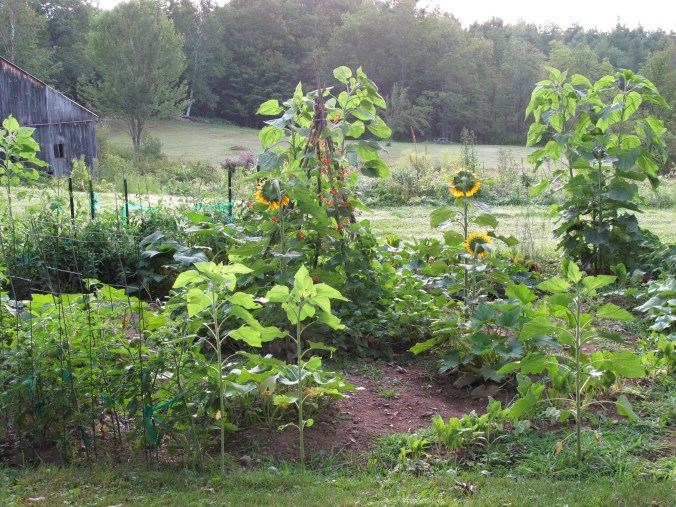
Garden in August 2009


A couple of weeks ago I was reading the blogs of young farmers across Ohio, New York and Vermont lamenting the loss of their crops due to an unexpected frost.  They had started all of their long growth veggie plants indoors, nurtured them, fussed over them, dreamed about their potential.  The weather warmed a couple of weeks early and in the eagerness that befalls us all when we think spring is here they transplanted everything into their newly tilled beds.  They were watered in, possibly staked up, fussed over some more.  The following week we had 3 days of below freezing weather – all of their sprouts were lost.  That’s a true hit for a small farmer.  You try to do everything right, avoid starts coming in from some other state or parts unknown.  You want to know how they were cared for, no one will love your little plants the way you do.

A similar thing is happening to me right now.  We’ve had very rainy, cold weather for the past week and a half.  Yes, right after I transplanted my starts and put my seeds in the ground.  I waited, I always do.  The official Memorial Day weekend this year fell on May 25 and 26 this year.  Too early to plant I said to myself, I’ve been burned before and the soil temp wasn’t high enough to germinate seeds.  I waited another week.  The weather wasn’t great but between a couple of rainy afternoons I got everything into the ground.  The following week was hot as blazes, it felt like late July.  Things were looking good.  The waiting is the most difficult for me.

It turned fairly cool a little over a week ago and it’s been raining a lot.  The sump for the cellar was running non stop last night as it does when the water table is extremely high – not a good sign.  I woke up this morning to a temperature of 48 degrees.  The rain had stopped right before dawn and I walked the garden with the dogs.  Beans and corn are up for the most part, rhutabagas as well.  Radishes, onions and all of the tomatoes look okay for now.  No potatoes yet which isn’t what I’d like to see and the Long Pie Pumpkins will probably have to be replanted.  I take heart in the fact that it’s still early enough to get a harvest from those things I have to replant but I’m also just waiting for signs of blight on my tomatoes, they’d rather have it sunny and warm you understand.

If I had to survive on the things I grow myself I would be scared right now.  There are so many crop issues that this weather has effected.  Things are slow to grow.  The fields are so wet that haying will have to wait (with a little prayer that it won’t rain like this for a while). Some times it’s difficult to put yourself into the shoes of your ancestors, so many of mine were farmers.  How must they have felt has they stood in the middle of their corn field with the plants 2 to 3 inches tall and fully a third of said field under water?  We take for granted that someone else is growing our food for us, they are the ones taking the risks.  We complain if the price of things go up or if fresh veggies are more difficult to come by but think about if food production was your whole life.

I’m convinced the day will come when a very large percentage of what I eat I will have to grow myself or in cooperation with my neighbors.  I garden because I love it but I also know that you can’t just decide one year that you are going to grow your own food.  In New England (and probably everywhere else) each growing season is different.  Every year I learn something new because I have to deal with some problem from the weather or pests.  You learn, you grow, you change.  The variety of food I grow is different from what I grew 10 years ago.  Part of that is that my garden has expanded over the years, part of it is there are things that just don’t do well in my particular spot.  Each year I try something new to see how it goes.  There are winners and losers.  I’m hoping that things warm up and dry out a little now or we will see what really survives in an adverse weather year. I’m also praying for a little more patience, things have a way of working out.

Maltese Cross Finished

130609 Throw (2)

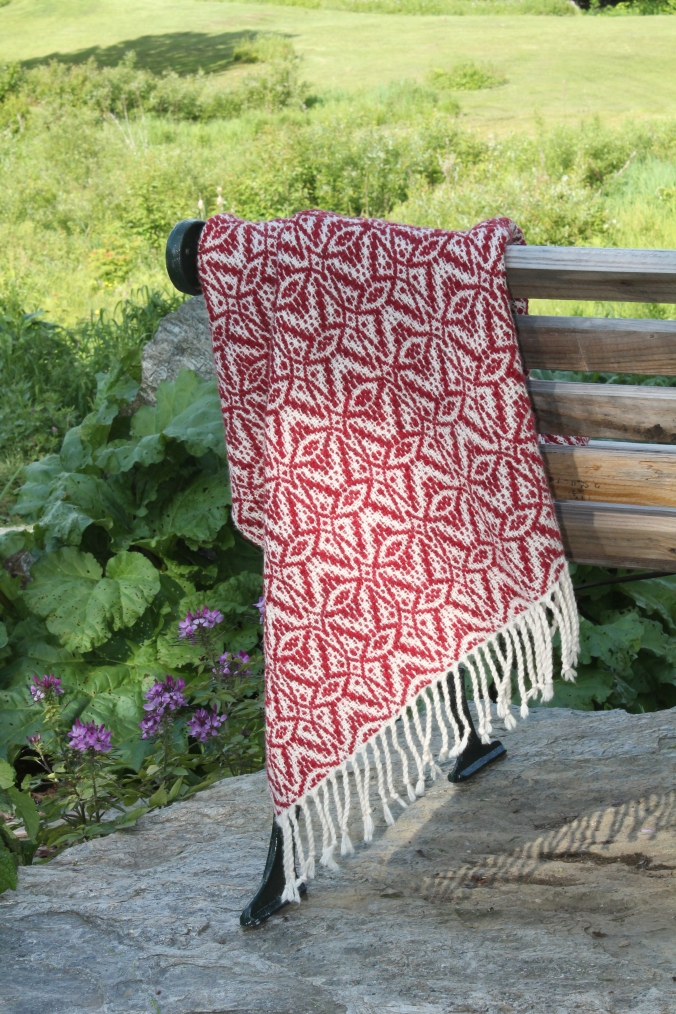
I finished the Maltese Cross overshot throw this past weekend.  I don’t know when I’ve felt more proud of a project.  So many different steps go into something like this, it’s the perfect foil for someone who bores easily.

After taking it off of the loom I took out the sewing machine and sewed the edges along the weft before the start of the fringe.  I then put it into a sink full of cold water and shampoo (just a touch).  I had a minor freak out when the water turn red with fugitive dye.  Eeeeekkk!  I rinsed and rinsed.  Whew.  Then I added a little conditioner and rinsed again.

After air drying overnight I cut the tabs off of each end to release the fringe and twisted and knotted it with a total of 8 strands in each ply.  What a nice finish that is.

It is so soft, so beautiful, I can’t stop looking at it – and touching it.

Now I’m planning the next one.  It has given more urgency to finish weaving the cotton towels now on the loom.  I just need more hours in the day!

Community and Communication

3 Adirondacks

Today sister Sue sent me an article entitled How Not To Be Alone  that was published this past Sunday in the NYT.  As I was reading it I was struck by how I’ve seen every technological change that was talked about in this article.  Growing up in a small, small community helped me see these changes in a more personal and much slower way.  Cell service is still non-existent in the town but the internet arrived a little while ago.  Our friends still drop in for unexpected visits which I always find delightful.  I think it says a lot about the relationship when you are comfortable enough to just get into your car and drive to a friend’s house expecting a quality visit.  The friends we have in Rowe are all comfortable with interrupting our day, they know we don’t see it as an interruption but as a time to reconnect.

It’s not the same in Enfield.  You cannot drop in on friends without an appointment.  People’s lives in suburbia are a very different thing.  Everything is so much faster, more frenetic.  I have lived in Enfield since 1984, we have lived in our house since 1998.  I still do not know my neighbors even though I can walk around the block and see what everyone is watching on their televisions on any given night – and I can walk it in less than 10 minutes. We have a few long time friends but they are not people we see on a regular basis – it’s always good to visit with them but it doesn’t happen often.

My kids would tell you that the reason we don’t have relationships with people in Enfield, where we spend over half of our lives right now, is because we are never here.  I think the real reason we are never here is because we don’t have the relationships we have in Rowe.  We have a community in Rowe, people who care enough about each other to stop by and talk face to face.

A couple of years ago I had internet put into the house in Rowe.  I did it because the girls always complained about not having it, they were disconnected.  I tried to convince them that it was a GOOD thing.  What has happened over the past couple of years is that I use it more.  I use it to communicate with them.  It saddens me to realize they will probably never realized the joy of friends dropping by without an “appointment”.  Our gatherings are more planned, just as joyous but I think something is lost in the spontaneity.

Strawberry Simple Syrup and the Finished Ruby Rocket

130608 Strawberry Simple SyrupThe local strawberries are out so I picked some up to make the next vital ingredient in the Ruby Rocket – Strawberry Simple Syrup.  Since simple is the operative word here I will just give you a brief description of what goes into it.  I used 2 quarts of strawberries hulled and halved.  They were put into a saucepan with 4 cups of water and brought to a boil, then simmered for 10 minutes.  The strawberries will have lost most of their color and look light pink. I used a small colander to drain the liquid into another saucepan.  Do not squeeze the berries in the strainer or your syrup will be cloudy.  Return the liquid to the stove and add 2 cups of sugar.  Heat until the sugar is dissolved, skim off the foam.  I then put the syrup into a couple of canning bottles and screwed on the caps. Once it had cooled down I put it into the refrigerator.  The sugar content allows this to keep for quite a long time.

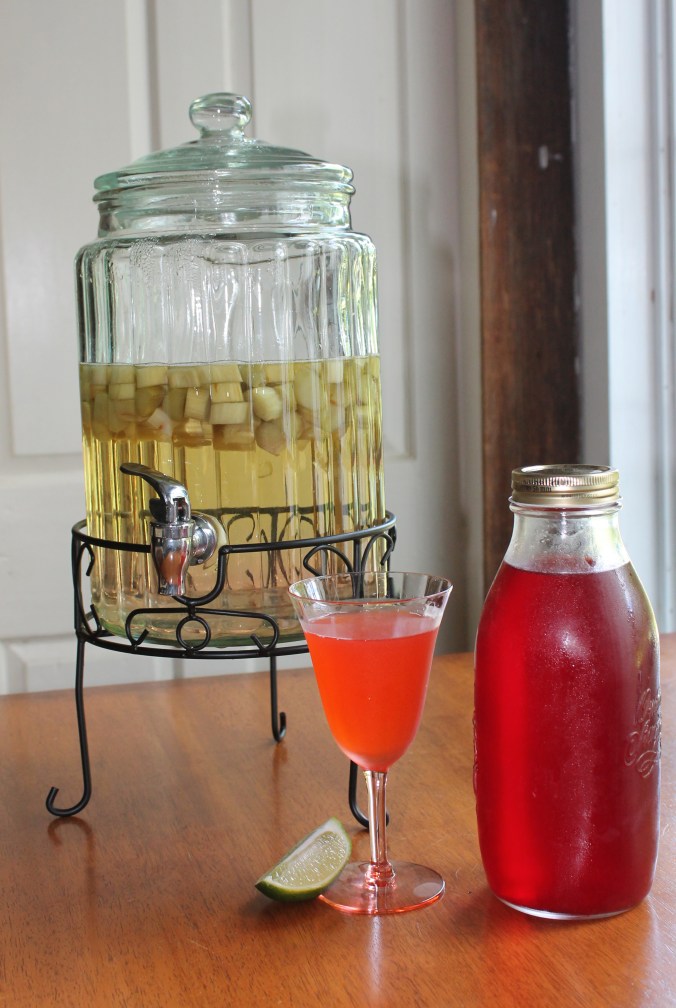
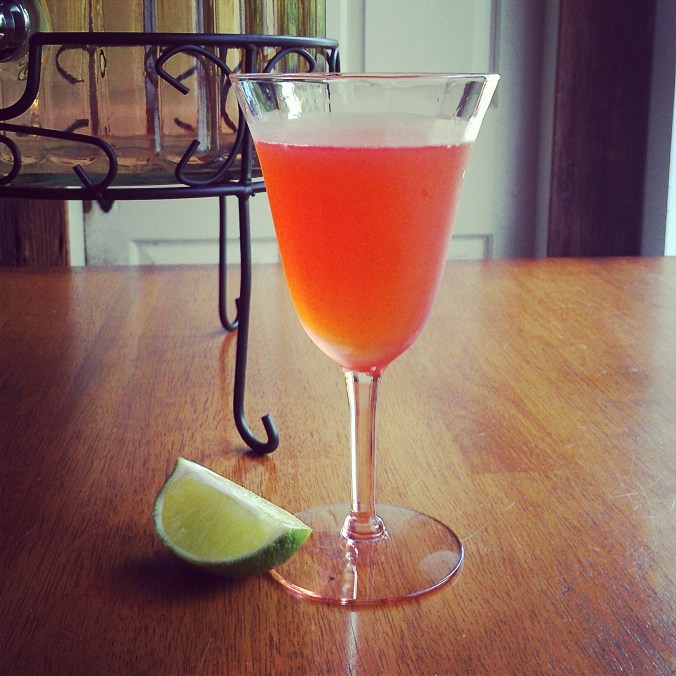
130609 Ruby Rocket (2)I pulled all of the ingredients together for the now famous drink.  The vodka had been infusing for 8 days.  In a martini shaker filled with ice I added the vodka, the simple syrup and a healthy squeeze of lime.  Shake, shake, shake, pour.   This can be made in proportions that combine the flavors in any way you want – tart or sweet.  You may need to make a few before you get exactly the taste you want.  Mine was maybe a little bit sweeter than I wanted but it tasted like the freshest strawberry rhubarb combo.

130609 Ruby Rocket (1)There you have it, the perfect Ruby Rocket.  Too much work?  Check out the Blue Rock Cafe if you are in Shelburne Falls, MA – they may have it.  If not they will certainly have some other fabulous infused vodka martini.


Dreaming of Possibilities

130606 Overshot

Last night I finished my overshot throw and took it off of the loom.  I’m amazed at how quickly the weaving went.  I will post a photograph of it once it’s finished.  I still have to sew, wash and do the fringe (twisted I think).  It’s quite beautiful and I’m pleased with the way it looks.  This was a lot of fun along with the frustration.

Taking this project off of the loom in class marked the end of weaving lessons until the fall.  After we took it off the loom Pam spread it out and said “Well, it’s beautiful, now you’ll just have to come to weave for fun because there is nothing else I can teach you.”  Yeah, right.  I have to say I have never taken a class where I learned so much in such a short period of time.  I’m excited at the prospect of the many, many new weaving projects ahead.  Every time I take something off of a loom the next project is rolling around in my head.  I haven’t really got the Maltese Cross out of my system yet so I will probably make another one on the loom at home in another color.  I’m also looking at other overshot drafts.  I figure since I’ve done one design it shouldn’t be a problem doing another, just read the draft.

I have a 40 minute drive to and from weaving class.  It always seems like it takes forever to get there in anticipation of what new thing I’m going to learn.  The drive home seems like it takes much less time.  I go over and over what I’ve done in the last 3 to 4 hours.  I think about the structure, the colors, the process.  I think that’s the sign of a good fit in craft – you dream of the possibilities.