Grand Opening

It’s been a whirlwind kind of week in preparing the Browning Bench Tool Factory for its Grand Opening this coming Saturday, the 15th.  The historical society was given the use of a building that was moved and restored in 1976.  It was originally a factory building used in the making of small hand tools such as hand planes.

The idea of building another building for the display of sleighs, wagons and large agricultural artifacts had been discussed during the latter part of last year but the cost of doing so was just out of reach.  The Bench Tool had been used in the past for exhibits of local crafts on Old Home Day but has basically sat idle otherwise.  It’s a barn essentially with no insulation but tight to the weather.  It has a good roof and windows.  We figured this would be the perfect annex for our agricultural display.

The sleighs, wagon, and large agricultural articles have been moved in, the smaller stuff has been making its way over.  This past week with work bees we’ve sorted things to different floors and by industry, season or animal.  There are displays about sugaring and skiing, tools for ice cutting and wood cutting.  Dairy, haying and harvesting grains are included along with bee equipment and chicken brooders.

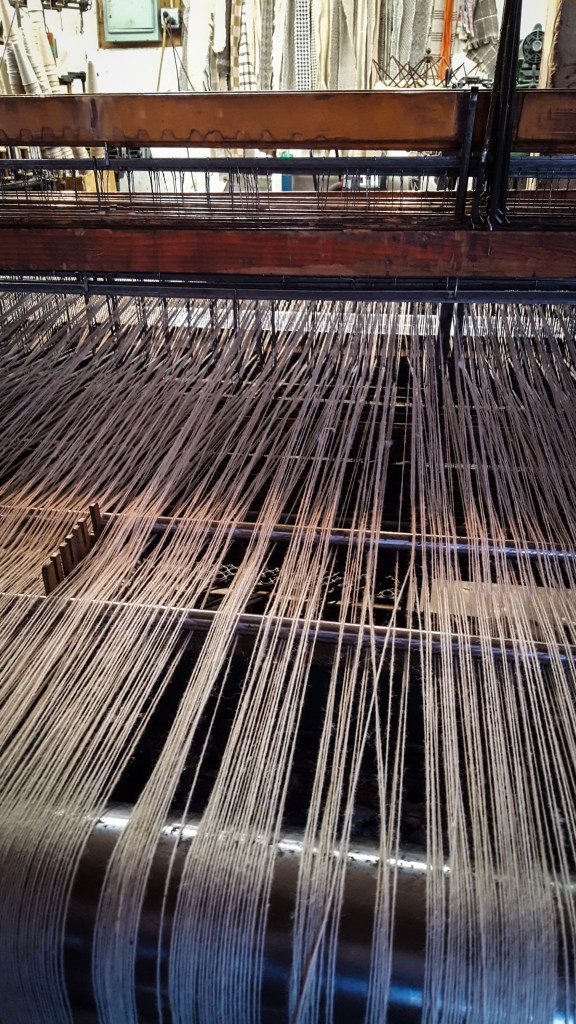
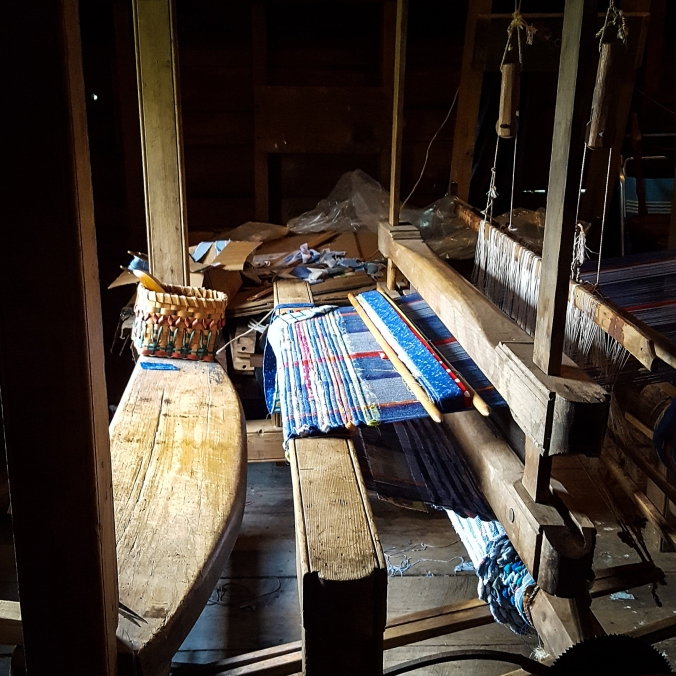
The third floor is a temporary exhibit on textiles and the manufacture.  Shirley (the loom) is set up and being dressed this week, I will be weaving there most Saturdays through the season.  There will be displays of other spinning and weaving equipment as well as some of the hand-woven artifacts from the museum.

One of the most important things for me has been the photographs.  The Historical Society has a treasure trove of amazing photos and I have scanned a good many of them in the past 10 months or so.  I’ve printed and mounted a great number of them to display along with the artifacts to put things in context.  So while the displays come together I think the photographs  will be the icing on the cake.  To see the town as it was 130 years ago is an amazing thing – open fields, amazing views, industry.  It’s difficult sometimes to wrap your head around it.

The trustees have come together and done an amazing job.  They all really care about the history of the town and sharing it with those that are interested.  If you are in the area on any Saturday through Fall from 10 A.M. to 2 P.M. stop by and see what we have in our newly expanded museum, there’s something for everyone.  Also consider becoming a member or lending your support as we continue to uncover treasures to share with everyone.

The Cloth

I apologize to my non weaving readers for something that may not be as interesting or easily understood but I have to do this.

There are three parts as I see it to this research project on the Satinet Factory in Rowe.  One of the most important to me was the cloth itself.  Having never seen a piece of satinet from 1840 or so I decided that the only way I could get a real visual of what they were making was to weave a piece myself.

I was pointed in the direction of a book titled The Domestic Manufacturer’s Assistant and Family Directory in the Arts of Weaving and Dyeing by J. and R. Bronson which was originally published in 1817.  The book is very informative and once you get the hang of the drafts they are very easy to figure out. This is a 6 shaft satin pattern.

So I did a little math, figured out the tie ups and started winding a warp.   Satinet was woven with a cotton warp and a wool weft.  I think originally it was for economic reasons.  Power carders and spinning were in place before the looms were so the mills prepared the fiber but the satinet was being woven by people in their homes on large barn frame looms.  Subcontractors in 1822 were being paid 10 cents per yard, or about $1.93 per yard in today’s money.  Satinet was also an inexpensive cloth to manufacture and the demand for it skyrocketed in the 1830’s  when clothiers began using the power-loom.

After talking to a few weavers who have an interest in historic weaving I decided that I would use 20/2 cotton and begin with a sett of 36 e.p.i. (partly because I have a 12 reed and the math was easy to do) . . . (sorry, not sorry).

I think cotton makes one of the most beautiful warps.  I love the sheen.  The question came up before doing this little experiment if the fabric would have been yarn dyed or piece dyed.  Everyone I talked to was in a different camp on this one so I decided to do a white cotton warp with dyed wool weft.  This also would make it easier to study the structure and see how the weft was covering the warp at different setts and beats.

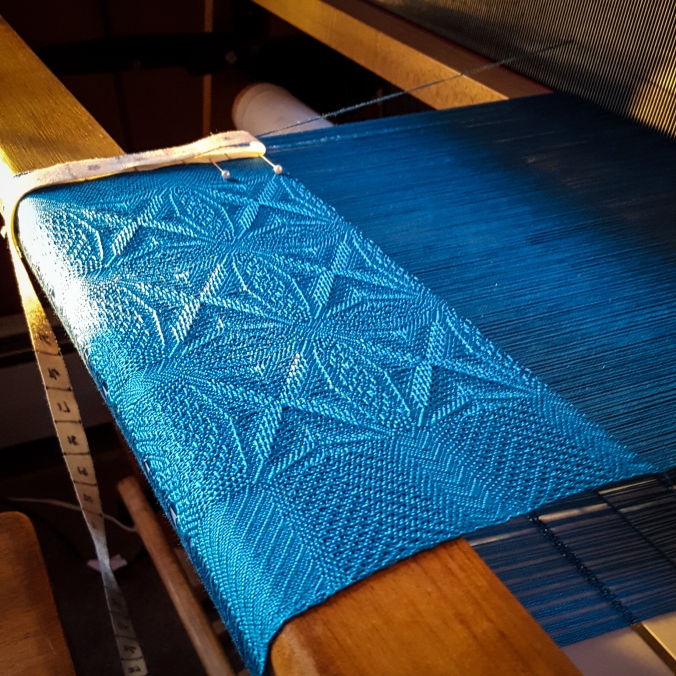
Woohoo, tied on and ready to go.  The piece in the loom was 6″ in width.  I used a single ply wool for the weft that seemed about the same size as the warp.  It was a left over warp from Peggy’s mill so I’m not sure of the exact size.   There were some slubs on the yarn which is what you see in the weaving.

I figured I’d start out with 36 p.p.i to make it balanced but found that I had to up my beat to attain 43 p.p.i. to cover the warp.  Also taken into consideration was the fulling that would occur in wet finishing.  I tried setting it higher – to 40 e.p.i. but that made a very stiff cloth.  I wove and wet finished 2 pieces at the two different setts with all different picks per inch, both about 12 inches in the loom.  When finished they both shrank to 5 1/2 by 11 1/4  which was much less than I expected.

The wrong side of the cloth is quite lovely, the fabric itself is soft and supple.  It was used mostly for trousers back in the day and you can understand it.  It has a nice hand but feels like it would wear extremely well.  It was also used for linings in coats and to make jackets.   Civil war uniforms were very often made of satinet as well.  My thought as I handled the samples was that I would love to weave some yardage for a jacket, it would be very comfortable.

My guess is this fabric would have been made with finer thread for a lighter weight but until I actually see a piece of it I won’t know.  The search continues here in town, we have an extensive collection of clothing.  I will also contact a few other museums to see what they have in their collections but at least now I know what I’m looking for.


WFH

When I started working with Peggy the only compensation I asked for was blankets to give for Christmas.  Quite honestly, being there, observing and helping in small ways was really compensation enough.

In one of my earliest posts about Bedfellows Blankets – It’s Always Something – I talked about the problems of badly spun yarn.  There were two jobs that were being woven for the same person with the same bad yarn.  One warp was finished and shipped.  The other has seen an off again on again relationship with the loom over the past 9 months.  Yes, that warp and I have been in close contact since I started going there.  It’s now affectionately referred to as the WFH (warp from hell).  Two hundred yards that have slowly and painfully made their way into cloth.

The pattern for the original job was a twill but had to be woven with double threads to give it more strength.  A little over 150 yards were woven, repaired and brought to the finisher before making its way to the customer.

lrm_export_20160907_155725-2

There were hours of mending broken threads.  Finally during the summer, with the cost overruns the customer cut their losses and there we sat with 50 yards or so still on the beam.  It sat there for a while.

lrm_export_20170107_141237

Peggy rethreaded it a number of different ways and finally began weaving a few throws when time permitted.  Warp threads still broke but different yarns for weft helped a little.

wp-1484224843761.jpg

It was still an exercise in frustration.  But . . . the finished throws were quite beautiful.  I decided these were the ones I wanted for gifts.  I brought a couple home – one herringbone and one plaited twill and wrapped them for Christmas.   I asked if I got some yarn for weft could we weave one for me.  I got a resounding  “Are you sure?”

lrm_export_20170107_140935

I got some lovely Harrisville Highland which proceeded to cause no end of problems because the weight of the yarn was just a little too much for the bobbin winder.  The temps were subzero outdoors and around 55 in the weave room.  Antique, oil-filled machines do not like cold temperatures so the process was slow.  Finally we were off and running.

Ahhh, I love that sound.  If you turn the sound up as high as it goes that’s what it sounds like with your ear protection on.  I’m not sure why my grandfather wasn’t deaf.

Well, we were stopping every 10 to 15 picks as usual.  The whole process was pretty painful.  Photographing is was – challenging.  During that little video two threads broke that I didn’t see on either side of the frame.  Yup, now I was just thinking about the repairs.

wp-1484225054251.jpg

Knotting the fringe was the final job before wet finishing – into the washer, cold water gentle, line dry.

wp-1484225465720.jpg

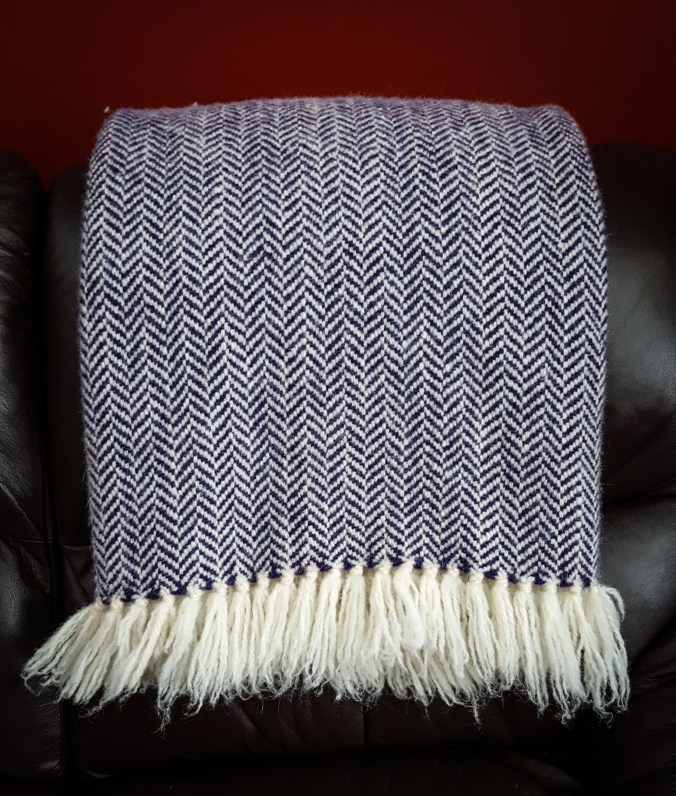
The finished throw is truly wonderful.  The yarn fulled as I expected making a soft, thick blanket.  The fringe looks almost like raw wool ( it almost is) because it had to little twist in it.  I probably should trim it and will eventually but I’m just enjoying it for now.

lrm_export_20170107_141353

These past months have given me a new respect for artists who create these treasures.  People will buy them and love them but will never know what went into their making.  The time, the care and often  frustration.

Peggy wove 3 more throws the other day while I was there.  One went pretty well, the other two not so much.  There’s probably another 20 yards on the warp and I asked her when she was going to be done with it – just cut it off.  She told me she was going to continue to work on it.  She did it to honor the wool.  So with time and patience that’s what she’s doing and for me that’s the most important lesson of all.

If you’re interested in one of these throws contact Bedfellows Blankets and ask about the WFH.


It’s a Matter of Perspective

lrm_export_20161005_192905

I’ve been reading a number of posts and memes commenting on what a horrendous year 2016 has been.  If I take a quick look back I might be inclined to agree.  This was a year of tremendous loss for me personally.  Four people I loved dearly passed away leaving some pretty big holes.  Then there was the weather – hot, hot summer, not much rain, a garden left to the weeds.  We won’t even go into the news or current events.

lrm_export_20161117_071740

In looking through the photographs of the year I realized that some pretty fantastic things have happened as well.  With the death of my father I was given the gift of time allowing me to be involved in things that are close to my heart.  This brought me into situations where I’ve met some great people and have grown in ways I never expected.

1609157

I’ve expanded my horizons by spending time with some wonderful weavers. They are the most generous people I know.  The weaving I’m doing today and the direction it seems to be heading right now is pulling from the history of the craft.  What began as weaving off a warp on a barn frame loom (a figure it out by yourself experience) lead to the purchase and moving of this type of loom to my house.  A mention of a few of these looms available in New England started the journey into bringing one home.  Snow and miles are not a deterrent to a weaver in search of a piece of equipment.

lrm_export_20160916_135108

This was also a year of reunions.  I’m not sure if it had to do with the loss of mutual friends or it was just timing but I spent more than a few of my weekends with people I love from past lives.  Calls out of the blue from friends I haven’t talked to in decades.  Calls from people on the other side of the world.  Calls to gather and just remember how much we truly like each other.

161017-charles-brown-diaries

It was a year of new-found friendship as well.  Like minded people coming together to work on projects of mutual interest.  Being more involved in a town of this size has brought me great satisfaction, friendships new and renewed and an understanding of the effort needed to keep it all together and keep politics out of it.  No easy feat.

lrm_export_20160915_191909

I think what I really learned is it was is all a matter of perspective.  My photography has helped with that – I’m a glass half full kind of photographer.  I try to share the wonder and beauty around me.  I realized a long time ago that worrying about the big picture is pretty destructive.  It’s not that I have my head in the sand it’s just that on a grand scale I know there’s very little I can to about it.  You can’t spend hours in the day projecting what is going to happen down the road, you don’t know.  Things unfold the way they unfold and it’s always in slower motion than you think it’s going to.

lrm_export_20161121_103355

Going into 2017 my goals are to learn more about the things I love and share that knowledge with those who will listen (and even those that won’t – sorry).  Perfect my crafts and teach others how to do these things.  Be kind and generous with my time.  Stay connected in a meaningful way to my friends – old and new – because you never know who needs what when and sometimes big change can happen by doing what you think is the littlest of things.  Most of all, never lose that sense of wonder.  There is so much to see and learn even in the smallest of things.

lrm_export_20161224_195550

Giving Thanks


wp-1479904276135.jpg

I watched American Experience on PBS last night – The Pilgrims.  I must confess that it was pretty dry and I had a tough time staying awake through the whole thing but it was enlightening in a couple of ways.

When the pilgrims came to America on the Mayflower they did so as refugees really.  They had been persecuted by the English because they refused to give up their belief system and be members of the Anglican church.  At the time you risked fines, jail or death if you were not a member of the Church of England.  In order to be able to practice freely they made a number of attempts to leave England as a group.  They finally escaped to Holland and spent 10 years worshiping in their homes.  They didn’t speak Dutch and the only jobs they had were menial in the textile and clothing industry.  They had nothing really.

What they did have was their community.  While in Holland they realized the culture of that country was not in line with their strict beliefs and worried about their children growing up in a land of loose moral character.  They wanted to create a community where they could grow in their beliefs without the influence of outsiders.   Living in a bubble of their own making they were truly naive about the ways of the world around them and taken advantage of by people at every turn trying to make their way across the Atlantic.  They left England very late in the year and arrived in New England on November 11, 1620.  Think about that – it’s now November 23 and it is cold.  They had just spent 66 days on a cramped boat and landed in wilderness.  No shelter, no food, nothing.  They survived but in greatly diminished numbers.

I feel many immigration stories are the same.  There is always some extreme reason to leave your home.  People don’t want to leave where they have lived, worked and played their entire lives unless they feel they have no other choice.  I think they also have the conviction that where they plan to go will be better.  Bill’s family left Lebanon in 1908 to come to America to build a better life and I would assume to escape political and religious turmoil.  How scary is it to use every last penny you have to get to a place where you don’t speak the language, don’t have a job or a place to live and you know no one?  I will tell you that the hardships they endured were incredible and probably not at all what they expected.  They had each other and their children and did what they had to do to survive with the conviction that this would be better at some point.

I wonder how far into their journeys did they wake up and think “what was I thinking?” or begin to lose sight of the reason for leaving home and country to begin with.  I don’t think we can really know the hardships they were living but I wonder if they thought the hardships they came into it were worth it.  There was no going back for them.

What they all had when they came here was community.  They had their friends, families or at the very least like-minded people with a similar plan in mind.  Today I can look at all of their situations and wonder how bad would it have to get for me to leave?  I realize even in the chaos and idiocy that has embroiled the country I have been in for the past 60 years I live a good life.  I have a home, heat and food on the table.  I have wonderful family and friends.  I am able to talk about anything I want – race, religion, politics – without fear of imprisonment.  I can make my own choices, go where I want, do what I want to do.  This past year has been a rough one on many levels.  The news is always sensational and instills fear in the hearts of anyone who listens but if you step back you have to realize that how your life is today is no different from what it was a month ago.  Fear is something that can take over your life and prevent you from living at all.

We all need to count our blessings.  Seems trite but without reflection and gratitude we can end up living a miserable existence surrounded by the things that have come to us through the true misery of others.  Look at what you’ve got, think of the life that you have and work on making that little piece of your world better.  Being able to do so is something to truly be thankful for.


Forty Year Journey

161017-charles-brown-diaries

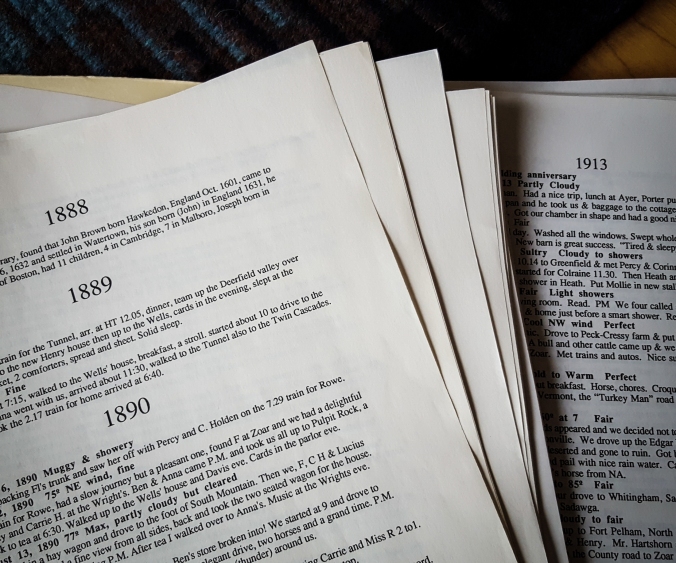
A couple of weeks ago a friend and town historian told me she had the diaries of Charles Brown and I might be interested in reading them.  Charles Brown was the father of Percy Brown who had written the first history of Rowe as well as being a large benefactor to the town.  She had transcribed each passage that referred to the time they spent in town from the years 1887 to 1929.

She dropped them off at the house and this began my breakfast and lunch routine of reading through the diaries.  I was immediately struck by the dedication to doing this.  He wrote every day.  He and his wife usually spent the month of August in town and he wrote about the weather and how they spent their days and evenings.

Well, either their thermometers were different or this is a testament to how much warmer it is now than in that forty-year span of time.  There were many days and nights when it was downright chilly.  He would often write about how many blankets he slept under to give you an idea of the cold.

When they began coming to Rowe they would stay at the “Wright house”, which is my house now.  There is something about reading about what was happening 130 years ago and having it take place right where you live.  He wrote about finding a horse and buggy to rent while they were here and the trips they would take daily around the area and into Vermont.

He wrote of the people around him, names so familiar but some too distant in the past for me have known.  He hired people to do jobs for him, had many visitors, read on the piazza, played hundreds of games of croquet recording the scores daily.  There was mention of murders, lightning strikes and fires.  He and Percy came to help when the barn here was struck by lightning and burned to the ground.

He wrote of his visitors.  He shared Percy’s friendships in Rowe, the places they all “tramped”, picnics on Pulpit Rock.  I learned of Percy’s engagement and marriage to Corinne.  Expected their visits year after year, then suddenly one line about her dying in Cincinnati.  At this point I was pretty invested in these characters and it felt like a gut punch with no explanation.  Thank goodness for public records and other info found with the diaries.

As the years went by the horse-drawn carriages and train rides to Zoar gave way to drives in new automobiles and how painful that could be.  Honestly, with the number of flats they changed it was a wonder they drove anywhere.  Of course there were always reports on how bad the roads were.

Friday morning I finished reading the remaining pages of the diaries.  I had been immersed in this wonderful little world of people, games and vacationing in a bygone time but a very familiar place. Charles was 79 years old.  His routine in Rowe had changed gradually over the years but in being able to read it in a few days time was compressed.  What really happened is I got to the end and went “Nooooooo”.  The story wasn’t over, it just stopped, ugh.  Think of it as Downton Abbey without season 6 – none of the ends were really tied up.

Social history is one of my favorite things and I have rarely, if ever, read anything so simply done give such a vivid picture of life in a bygone time.  I’m sad the story ended but think I will read it over again.  Like every good story you read to see where it goes, this time I’ll read it again to pay more attention to what it says.


Goodbye Doc

wp-1473379891481.jpg

Photo – Merritt Brown

I lost a very dear friend yesterday.  2016 has been a rough year.

I met Merritt (Doc) Brown 40 years ago almost to the day at Hallmark Institute of Photography.  We were the third class to go through the school with a class size of a little over 30 people.  At the time Hallmark was a different place than it grew into.  It wasn’t accredited, you couldn’t get financial aid, you had to really want to be there.  It was also the first place in my entire life that I felt like I belonged and one of those reasons was Doc.

I am sharing some things here that will probably not mean as much if you didn’t know him but somehow it feels like everyone knew him.  When we were in school I thought he was probably the worst photographer I had ever met – truly.  He understood the process – his vision, exposure and printing – not so much.   I never saw him in any commercial realm of photography (at least as it was at that time – we’re talking 1977) but he had such a passion for what he was doing.  We’d be given assignments and many critiques were cringe worthy.  He never gave up and graduated with the rest of us (although in a recent conversation we both confessed that neither of us knew how he got through).

Now I can’t speak to how Merritt was before the “Hallmark experience”.  I do know that our time in that place changed us all.  It made us understand the value of friendship and the importance of maintaining the relationships you have.

Merritt had more friends than anyone I ever knew.  He maintained them well.  With the advent of social media he really came into his own.  Through it we could see that his passion for photography had only grown through the years.  He shared his images and his sometimes twisted philosophy with so many of us.  Always quick with a smart remark or advice or simple observation I looked forward to his running commentary on my life.  It was always positive.

This past year we had conversed more than usual and more about life in general than photography specifically. We shared the experience of children lost and found, something rather unique in my circle of friends.  I’m glad it was with him because he always could be counted on for truth in any situation.  He could see things as they were and would tell it like it is.  Last week I visited him at home and the conversation was more poignant.   He wished he had more time with his children and grandchildren.  It killed him to know that he wasn’t going to be around to enjoy some of Manop’s cooking. Fishing, he hadn’t been fishing at all this year.  He had a habit of shooting daily, was limited to home but he still had images to share with his friends. Clouds, he could photograph the clouds and since that’s where he was going he wanted to share them.

He knew he was at the end, he knew some of it had to do with the choices he’d made in life but there were really no regrets.  It had been quite the ride.  So this kind, gentle, larger than life soul left this earth yesterday and we are all sitting here in disbelief.  For me it’s left quite a hole.

My daughter-in-law recently commented on how many friends I have.  I’d never really thought about it before.  I do.  I have circles of friends from different times in my life.  I’ve maintained the ones that are most important to me.  Until now I didn’t realize there’s a downside to all of this, you have to move through losing them.

Our friends make up who we are, some more significantly then others, they teach us how to be.  We try to surround ourselves with the people who make us our better selves.  That’s what Merritt did for me, he made me just a little bit better.

Learning New Things About Old Things

160722 Chester Photobomb

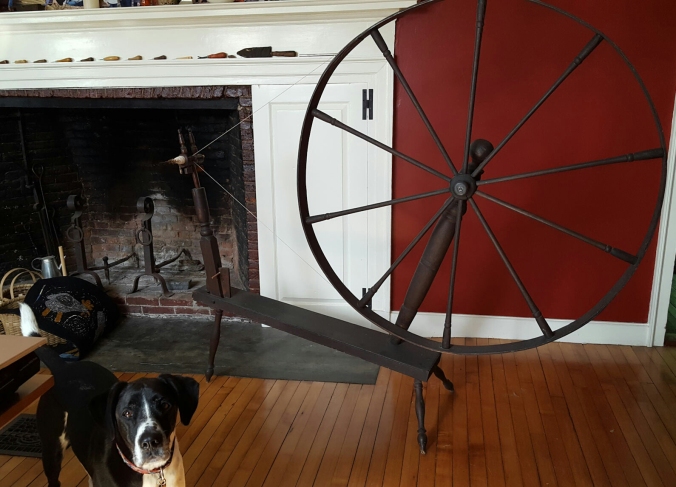
This morning I was doing some photography for a book that Peggy is writing on wool.  It’s been a long time since I’ve taken photographs for someone else, let alone tabletop items.  It was stressful and wonderful at the same time.  She also wanted a photo of my wool wheel in a specific place.  As you can see I had more than one obstacle to deal with.  He is a master of photo bomb.  I had to physically remove him from the area.

Along with the photographs I took was one I had to scan.

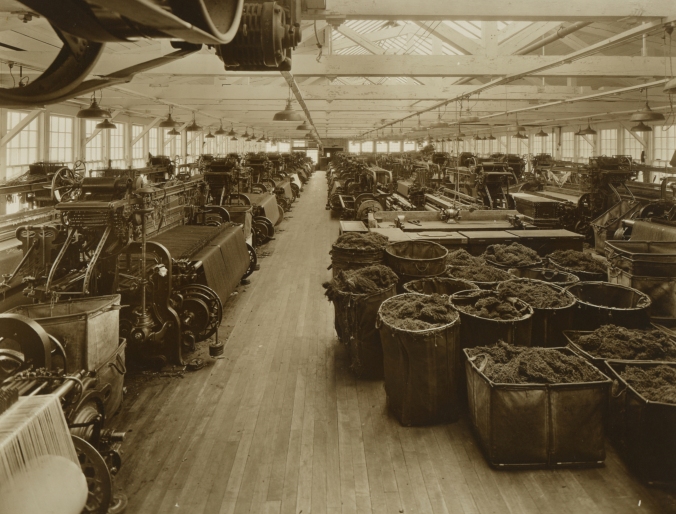
Charlton Woolen Weave Room

This is a photograph of the weave room at Charlton Woolens probably taken in the mid to late 1930’s.  My grandfather’s toolbox is one of many in the photograph.  This photo was one of the many reasons I wanted to experience the Crompton and Knowles power looms. In doing so this photograph is so much richer.  I now have an understanding of what was happening in this room, where the weavers stood, the noise.  I look at this photo and think about how you must have felt the vibrations in your feet and gone home with your ears ringing.  I have a better idea of the kind of job a loom mechanic had.

I’m always amazed at just how long research takes when it comes to history if you want to understand the whole story.  Genealogy gives you the names and dates of the people – the who, what and where kind of thing.  The photographs, when you can find them, begin to fill out the story.  Then there is the living history.  This is far more elusive but when you find it you can put yourself in your ancestors shoes with a little bit of imagination.

Social history is what makes studying the past come alive.  It’s where you begin to understand a little about the way people thought about their world and made their life decisions.  Public records give you clues into things.  You begin with the big stuff – politics and religion and work your way down to minutia.  Things like what were they wearing and how did it affect how they moved and did their work.  You look at how men and women treated each other, how economics made or broke their lives.

I think there’s been an injustice served on the American people in not teaching our history in a way that is accessible to everyone.  I think a lot of the turmoil that we see is a lack of understanding of what has gone on before.  I feel like people are making up things as they go along in a way that is only self-serving. Their knowledge is so narrow.  Maybe because social media has taken over our lives and rather than read a book we read twitter every morning.  I think the idea of knowing our history has been lost.  It’s too bad because some of the greatest stories ever told are true.

I plug along learning new things about old things everyday.  I’ll continue to put myself into situations where I can understand what was going on or the work involved.  One year I dug my garden plot completely by hand so I could feel what kind of work went into putting in a kitchen garden for the women of 1840.  It’s one thing to read about it, quite another to do it.

The real goal is putting the family history into words with understanding.  Not just any story, a story that makes these people human. One that makes you understand that the world could be just as scary a place to them as it sometimes is to us.  History repeats itself, over and over, but unless you know something about it you don’t recognize it when it happens.


Manic

wp-1463657742940.jpg

A couple of days ago I finished a 10 yard run of towels and took them off of the loom, hemmed, washed and folded them all in one afternoon.  This never happens, I have things I have yet to finish from last year.

When I near the end of one project I’m always moving on to the next and my excitement may get in the way of the finishing part.  That’s my theory anyway.  I’m in wedding present mode and asked one of my nieces if there was anything in particular I could make her that would be useful.  She asked for a specific type of towel.  I asked what colors and she said something to the effect of light shining through ferns.  She is an amazing artist and thinking about projects for her pushes me creatively.

I found a modification of an old draft that I modified further and worked up half a warp yesterday hoping this came close to ferns.  As I was winding it I decided to call it “A Walk in the Woods” because it had the colors I envisioned when I walk onto the fern lined path headed into the wood lot in the back forty.

wp-1463657742944.jpg

Today I’ll finish winding the warp and possibly get it onto the loom.

Right now I’m in that creative manic mode that seems to really set in after a loss.  When my mother died I made quilts and rag dolls – lots of them.  I gave most of them away to my friends.  Again, it’s the process, not the product.  Weaving seems to be what’s on the agenda right now although I do have a knitting project going as well as needle felting, rug hooking and, oh yeah, the gardens.

This time around though there’s a different sort of feel – like time is getting short and there’s still so much I want to do.  Maybe it’s that generational shift that comes when you lose your last parent.  Maybe it’s the realization that if you’re lucky you have a quarter of your life left to go and who knows how productive all of it will be.

Most of the time I don’t really think about it but on those days when all I can think about is the project I’m planning and working on to the point of no sleep it does make me wonder.  I think some of it is a distraction, maybe a defense to fight off the depression that could take over or the overwhelming sadness at moments.  What’s the saying? “Idle hands are the devil’s workshop”.  I just have to keep going, keep creating.

The Hipocrisy of It All

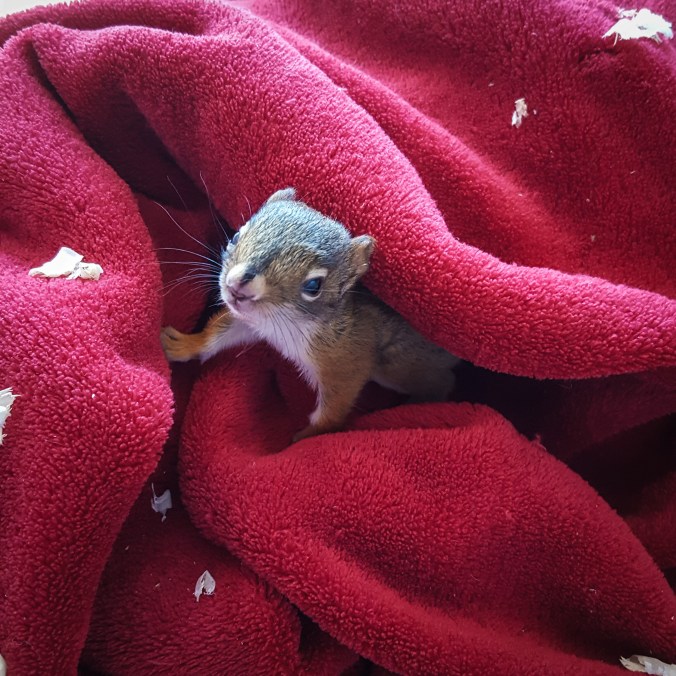
160510 Red Squirrel (1)Yesterday the sun finally came out after a week of cold, rainy weather.  Our lawn was beginning to look like a hayfield so I decided to take out the lawn mower.  When I engaged the blades something few out from beneath the mower and I thought it was just a leaf but out of the corner of my eye I saw it kept moving.  It was a baby red squirrel, not quite able to run, trying to crawl away.
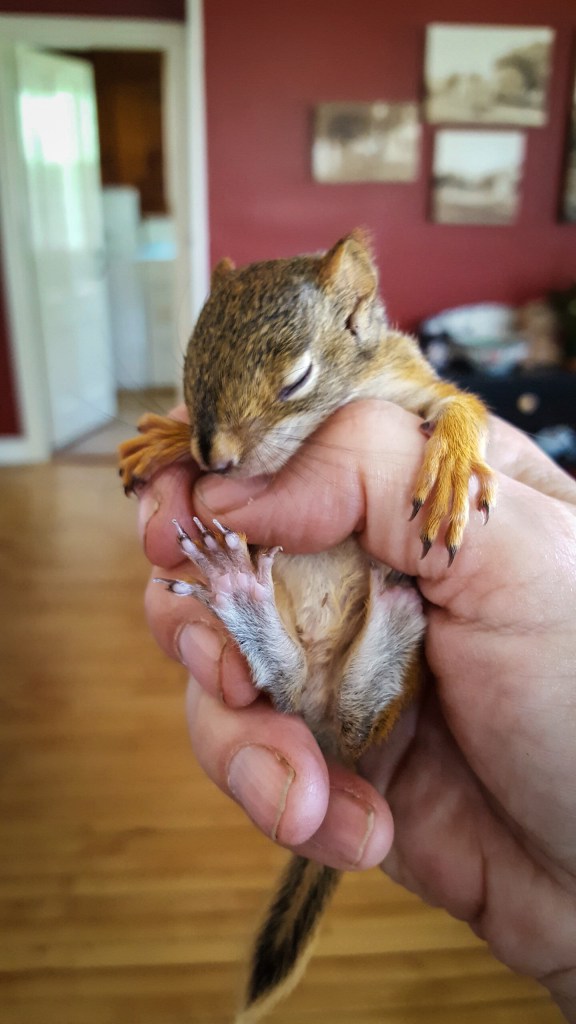
I got off of the mower and took by jacket off to pick it up (I didn’t know if it would bite me).  When I picked it up the shivering little thing curled up in the warmth of the fleece.  I looked all around for signs of other squirrels or a nest but found nothing so I put a warm bottle of water underneath a small fleece blanket and tucked him into it.

Okay, I have to tell you that I am not a fan of red squirrels, they are destructive little buggers that get into everything.  I have a good many of them that spend a lot of their time on my bird feeders or in the shed trying to get into the containers of chicken feed or bird seed. If they feel trapped in any way they chew their way out.  We trained Chester this past winter to chase them away from the feeders and would send him out multiple times a day.  He thought it was fun and an important job, sadly the squirrels were much smarter than he was so it was really just a game played over and over again.

This was a seriously cute little animal and I couldn’t imagine just putting it back outdoors to surely die of starvation, exposure or owl fodder.  He let me pick him up and was pretty content in the warmth of my hands.  He’d hang onto my fingers.

160510 Red Squirrel (3)

Years ago we had friends that raised a baby squirrel, he’d ride around in their Dad’s shirt pocket so I googled care and rehab of squirrels.  Yeah, uhm no.  Who has that kind of time and energy?  Sure he’s cute, sure I don’t want to be the one to bring him back out into the cold world to starve. Ugh, I hate this sort of thing.

I called my vet and she gave me the name of a woman who rehabs wild animals and birds.  When I called her she said she’d take him but it would have to be later in the day and to just keep him warm.

So over the course of the next few hours I continued to keep the hot water bottle hot and held him off and on just to check him out and give him a pat or two.  Made sure my sister came up to see him.  It’s so very rare to get up close and personal to a wild creature to really inspect them.  The paws are amazingly long, to grasp and climb.  And the whiskers . . .

I took him on a little car trip and dropped him off to be cared for with 17 other squirrels (this is the only red one).  It was with a sense of relief that I didn’t have to send him to his doom as well as knowing that he would be set free when old enough far away from my back yard.