Generations of Service

We have someone in our family that has fought in every war from the Revolution except for Vietnam.  Our family tree is full of stories of battles, command of regiments and battalions, unusual jobs.  I can imagine the mothers, wives and daughters caring for property and finance when their men went off to war.

Some were volunteers fighting for things they sincerely believed in, others were drafted.  They all seemed to travel to foreign places returning home with exotic and exciting stories to tell their children and grandchildren. Those stories were part and parcel of my childhood.  Some were just information, others were fantastic tales. We were brought to believe that service to our country was proudly taken on.  They were tales of camaraderie and the craziness of youth.

The things that have stuck with me is that they all saw their times of service as one of the greatest things they ever did.  WWI, WWII, Korea, The Gulf War, Iraq, Afghanistan – these are the stories I know, the ones that I have heard first hand. The stories they tell are always about the men they were with, working as a team for a common cause. Many times that cause was just staying alive.  They tell their stories with a sense of humor and I’ve often thought that it’s a way to keep the fear of those situations in check, or the telling of the stories helps them make sense of them.

This is my father.  He was in the Navy from 1951 until 1954 on the USS Northampton as a boilerman. His story was one of travel to foreign lands.  The war was going on in Korea but he spent his entire tour in the Atlantic – Spain, Greece, Haiti, Cuba.

530901 Dick in Navy

Generation after generation has served.  My brother is still serving.

Thanks to all servicemen and women for the sacrifices you have made and continue to make and the stories you have and share.

Flashback Friday – Our first renovation project

I thought I would share a few old posts over the next few weeks.  It will help give me a little perspective.  These posts were migrated from another blog spot so I apologize for how wonky they look in WordPress.

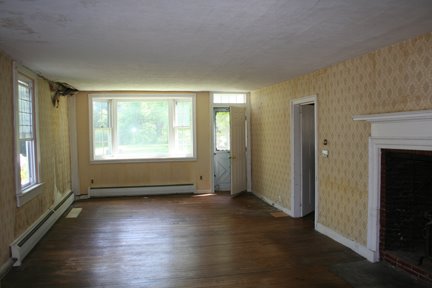
We are about to begin one of the biggest restoration projects to date (and our first in Rowe). By big I’m referring to area. Without measuring we figured this room is about 28′ x 15′ – I think that may be a conservative guess.

The barnboard on the end wall is going to stay – Dad told me it was put up originally because the plaster was falling off the wall. This kind of repair seems to be the way it’s been done in sooo many of the old houses we’ve worked on (or visited).


As you can see the ceiling is coming down in the far corner – it’s been like this for a couple of years but there are other points in the ceiling that are really beginning to sag so we’ve decided to gut the room, insulate and drywall. If it was a true restoration we’d be mixing up the plaster but it seems to be a lost art (and we don’t have the time or knowledge to do it). The window that is closest on the left actually has a deep ledge, almost a window seat. That whole window is being removed and replaced to bring it back flush with the wall. It overhangs the patio with a small roof and the whole structure is rotten and looks like its ready to fall off.

Of course this is the kind of help Bill will have for the week – they look better earlier in the day. God help him is all I have to say.


I’ll post next week on the progress – I will at least have shots of the demo – 200 years of dirt. Everyone will be in respirators, fun is.
We began the living room project in June of 2008.  It took us 3 years to finally finish it (these kinds of projects seem to stretch out when you are only working on them on weekends).  We had a lot of help along the way from people that know what they are doing.  It’s good to have friends like that.  Here’s a shot of what it looked like after the floor was finished.
Amazing
We are thinking about another room restoration and I have to keep reminding myself what a long, tedious thing it is to do.  But with every room you learn.  You gain skills that make the next job easier.  We’ve done 2 bathrooms and many bedrooms, halls, etc.  The next project will be a room upstairs, a rather large one.  It was once a bedroom but the plan is for it to house my looms, sewing machines, fabric and fiber.  It’s been in boxes too long and having it have a place of its own will only free me up to be creative rather than looking for what I might want to do next (or shopping because its too tedious to search).  I wonder how many duplicate tools I will find when the unpacking begins?

2013 – Year of the Great Fruit Fly Infestation

Fruit FliesEvery year we have fruit flies as summer turns into fall.  They are a little annoying but if you pick up any food or things that are damp you can usually control the situation.  For the past month we have had an infestation like I have never seen before.  They were everywhere.

I went through everything, cleaning, washing, sanitizing.  We would leave on Sunday night and I would come back on Wednesday, turn up the heat and they would be everywhere.  They weren’t confined to one room either.  Every room downstairs had fruit flies.  The past couple of weeks have been pretty cold so I figured that would do them in – not so.  It felt like black fly season in my living room.

I put out an APB to all of my cyber friends and family.  Some replied with great advice.  I googled how to rid yourself of fruit flies and tried many things suggested.  Two weeks in a row I set out bowls of cider vinegar with a couple of drops of detergent.  It worked quite well, except for the pesky buggers that would hang out on the rim of the bowl like birds on a birdbath.  The bowls were in every room and it seemed like the population grew from week to week.

One morning I was at my wits end with a swarm around my head.  I sat down to think about this – what was keeping them going?  There had to be a food source of some kind for them to continue to multiply like this.  Then it dawned on me – there were potatoes gone bad in a wooden bin in the kitchen.  It hadn’t even crossed my mind.  I had Bill remove their life source and waited another few days.

I am happy to say when I arrived last night I was pleasantly relieved to see they were gone.  Not a one anywhere.

I must admit I took a perverse pleasure in sucking up their dead little carcasses with the vacuum cleaner.


Helping Hands

131102 Wood (1)It must look as though all we do is cut, split and stack wood by the numerous posts about it here.  This time of year that does seem to be the case.  I have to tell you though that this is one chore that I kind of like doing.  It is the one thing we do as a little community for the most part.  This weekend we went to sister Sue’s to move some of a huge locust tree that came down at the end of the summer.  The tree guys cut it up in place and hauled away the sticks and branches (the worst part of the job).  They cut the wood to length but it needed to be moved and split.  The morning began with the tractor ride to her house, Bill followed with the splitter.  A friend arrived shortly after we did and then Sue’s daughter and her husband.

The tree was at the back side of her house so Bill, Rob and Chuck all loaded the bucket of the tractor and the bed of a pick up with multiple loads and brought it to the door of the barn where we had set up the splitter.  Sue has a door in the floor of the barn and we split and tossed it through the door into the lower level.  This is really an excellent set up.  It keeps the wood out of the weather and is attached to the house so in those howling snow storms she just has to walk down the stairs to get her wood.  Not ideal going up and down the stairs but much better than keeping it under a tarp in a field somewhere.

Sue and I split the smaller pieces but a lot of it was huge.  The splitter can be used horizontally or vertically.  The vertical position allows you the ability to split any size diameter wood (you just have to be able to move it around).  One large chunk was split into 30 plus pieces – Sue counted. Moving and splitting went on for four hours or so – 3 tanks of gas is how we measure.  The wall of wood was a little intimidating initially, they were bringing it up faster than we were ever going to split it. Bill figures they will get 5 cord or more from that one tree.

This kind of work is fun, especially when you have a group of people working towards that common goal.  It’s nice to work with people that have experience, a lot can be done without a lot of instruction.  Time can be spent working and laughing.  And if you’re with my sister you can bet you will be taking stock of what kinds of mosses are growing on any given piece of wood – I did see her set a piece or two aside for closer inspection later.

131102 Wood (2)

Marriage Isn’t For You

Great post, words to realize and live by.

Seth Adam Smith's avatarSeth Adam Smith

Having been married only a year and a half, I’ve recently come to the conclusion that marriage isn’t for me.

Now before you start making assumptions, keep reading.

I met my wife in high school when we were 15 years old. We were friends for ten years until…until we decided no longer wanted to be just friends. 🙂 I strongly recommend that best friends fall in love. Good times will be had by all.

Nevertheless, falling in love with my best friend did not prevent me from having certain fears and anxieties about getting married. The nearer Kim and I approached the decision to marry, the more I was filled with a paralyzing fear. Was I ready? Was I making the right choice? Was Kim the right person to marry? Would she make me happy?

Then, one fateful night, I shared these thoughts and concerns with my dad.

Perhaps each…

View original post 594 more words

Gold in the Back Forty

131027 Mushrooms This was an amazing sight to me the other day when I walked into the back forty.  It has been COLD for the past week and it was more than unexpected to see mushrooms growing.  The photograph doesn’t really do justice to how beautiful they are.  They are iridescent, like a pot of gold by a stump. They glowed on a cold, overcast day.

These mushrooms are called Honey Mushrooms (Armillaria mellea). I had to ask my sister for a direction in identification and after a little research found a great description on The 3 Foragers.

As beautiful as they are the thought of cooking and eating them never crossed my mind.  The extent of my foraging is stumbling upon mushrooms of some sort, looking them up to see what they are and moving on.  “Mushrooms are poisonous” was drilled into my childhood brain.  Even mushroom foragers have a saying –  there are bold mushroom hunters, and there are old mushroom hunters — there are no old, bold mushroom hunters.

Words to live by.

Family Flat File

131027 File (1)

There is a flat file in one of the old workrooms at the house in Rowe. It is probably 3 feet wide and 20+ inches deep ( I haven’t measured it yet).  The room that it has been in for as long as I can remember has a tendency to be pretty damp in the spring and summer.  Not having a dehumidifier has caused a lot of strange molds to grow in and on things that have been around for an extended length of time.  When my brother and I were cleaning out the room I laid claim to this particular piece.  It was used by my father, grandfather and I would hazard to guess my great-grandfather as well.

I decided that I would repurpose the box itself as a table in the living room.  It will need a base to bring it to height, that in itself solves one of its problems.  You see this was a utilitarian piece and was “modified” over the years.  It was filled with nuts and bolts, manuals and instructions, tools, spare and used parts.  It also had a collection of my father’s elementary school papers.  I cleaned out each drawer, everyone having its own story to tell.  Electrical in one drawer, old pocket calendars and date books from the 30’s in another.  There were probably 2 drawers of tools and parts for looms which seems to be an ever-present theme in every work room or shop on the property.

I kept what I could in a couple of boxes and set them aside.

The entire unit smelled of mildew so I pulled out all of the drawers and decided to let it dry and air out.  It’s been doing that for over a year now.  This past weekend I started cleaning it up. It cleaned as well as can be expected since it has probably close to century’s worth of dirt and grime on it.  It no longer smells.

I’m in kind of a quandary about my next move.  This thing is splattered in spots with paint (what looks like white paint in the photo above is actually a really reflective silver).  There is some green paint splattered on the side of the cabinet towards the back.  To strip and refinish or to leave it alone other than a bit more clean up.  I could just redo the top making it a little smoother (the varnish is crackled at this point).  I am more inclined to leave it the way it is and make up stories about what has happened to it over the years. All kinds of stories were in my head as I cleaned the stuff out of it.  If there wasn’t so much mold and mildew I might have just left some of the drawers the way they were. It felt as though the ghosts of generations past were still in there.

Bill thought if I was to strip it I could bring it to people we know who refinish furniture and have them do it. I told him the little secret that really made this piece special to me.  There are greasy fingerprints all over the bottoms of each of the drawers and I didn’t want them to disappear.  They are the prints of three generations of working men in my family and that spoke to me more than anything else.  I don’t want anything to happen to that aspect of it. The amazing part for me it the fact that no one will know about that little secret unless the drawers are removed.  For me this is what has made a piece of junk into an heirloom.

131027 File (2)

Weaving Wednesday – Round Robin 5

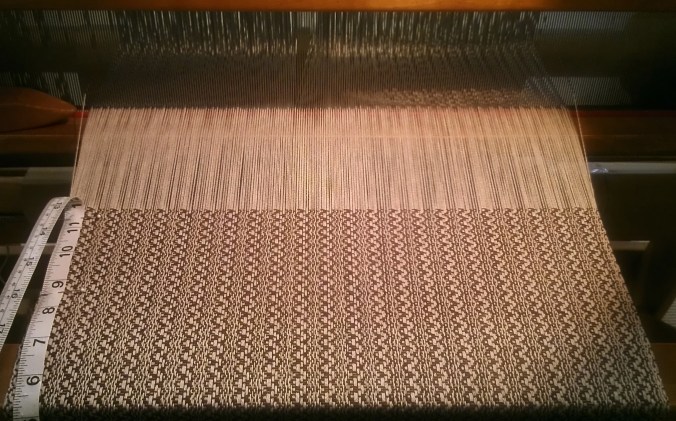
131023 Undulating TwillI arrived at weaving class 2 hours early on Tuesday with the idea that I would catch up – I was a towel behind in the Round Robin.  I decided to start with this undulating twill pattern. I remembered being told it would weave up quickly.  Sometimes it takes me quite a while to figure out what color to use for the warp but the person that wove the towel before me on this warp used the same color.  I love the way it looks, it reminds me of vintage fabric.  It took a little less than 2 hours to weave the 27″ for the towel and I wasn’t so fried from a complicated pattern that I moved on to another loom.

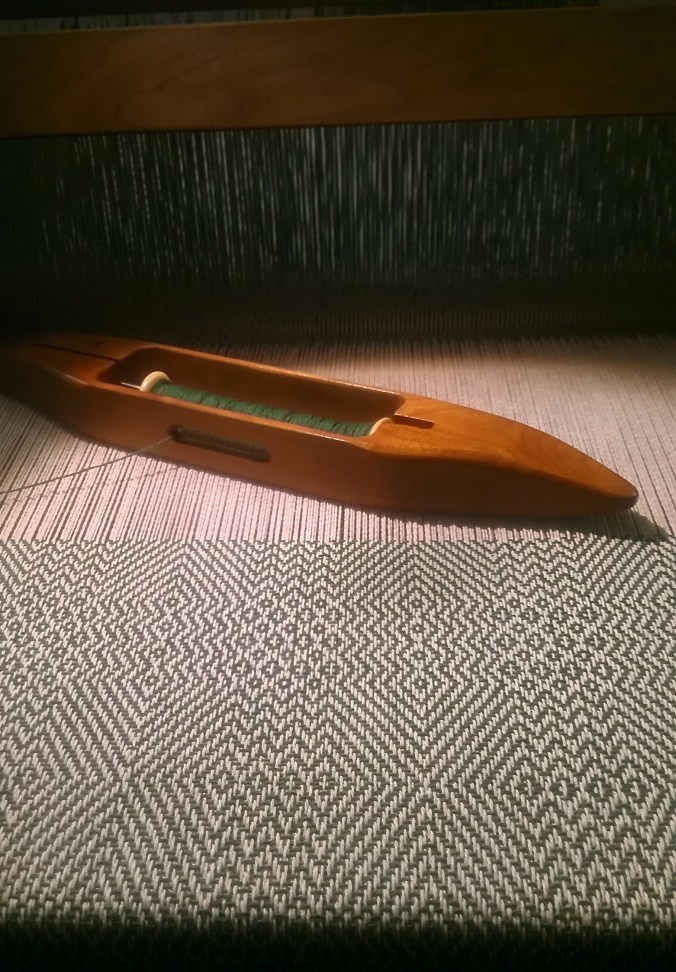
131023 Point Twill with HerringboneThis is a Point Twill with Herringbone pattern.  I have to say it was really fun to weave.  The results are . . . interesting.

Both towels are made in 8/2 unmercerized cotton making a nice weight, absorbent towel – isn’t that all your really need?  I am now caught up with 5 more towels to weave.  I can’t wait to have them all off of the looms and start hemming (not).

The Story of the Three Seeds

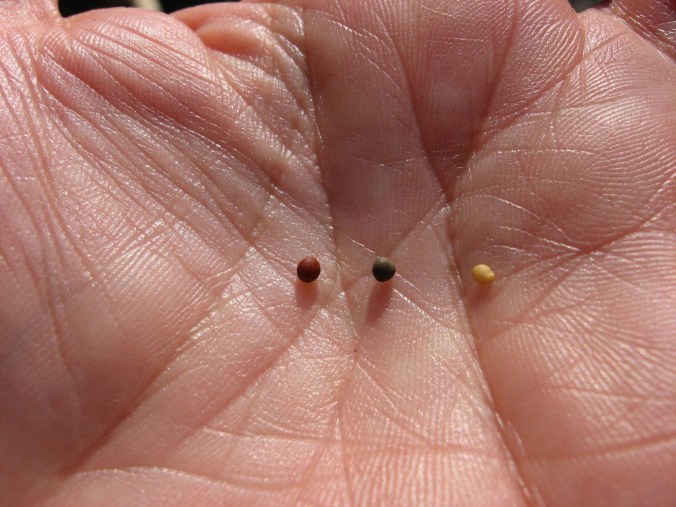
This morning I wanted to share a story I read on Sustainable Man on FB.  For all of the flaws that social media has this sort of writing is the kind of thing we should be grateful is shared.
1074882_10151791012507909_1760285906_o
Once upon a time, the tribe of humanity embarked upon a long journey called Separation. It was not a blunder as some, seeing its ravages upon the planet, might think; nor was it a fall, nor an expression of some innate evil peculiar to the human species. It was a journey with a purpose: to experience the extremes of Separation, to develop the gifts that come in response to it, and to integrate all of that in a new Age of Reunion.

But we knew at the outset that there was danger in this journey: that we might become lost in Separation and never come back. We might become so alienated from nature that we would destroy the very basis of life; we might become so separated from each other that our poor egos, left naked and terrified, would become incapable of rejoining the community of all being. In other words, we foresaw the crisis we face today.

That is why, thousands of years ago, we planted three seeds that would sprout at the time that our journey of Separation reached its extreme. Three seeds, three transmissions from the past to the future, three ways of preserving and transmitting the truth of the world, the self, and how to be human.

Imagine you were alive thirty thousand years ago and had a vision of all that was to come: symbolic language, naming and labeling the world; agriculture, the domestication of the wild, dominion over other species and the land; the Machine, the mastery of natural forces; the forgetting of how beautiful and perfect the world is; the atomization of society; a world where humans fear even to drink of the streams and rivers, where we live among strangers and don’t know the people next door, where we kill across the planet with the touch of a button, where the seas turn black and the air burns our lungs, where we are so broken that we dare not remember that it isn’t supposed to be this way. Imagine you saw it all coming. How would you help people thirty thousand years thence? How would you send information, knowledge, aid over such a vast gulf of time? Maybe this actually happened. So, we came up with three seeds.

The first seed was the wisdom lineages: the lines of transmission going back thousands of years that have preserved and protected essential knowledge. From adept to disciple, in every part of the world, various wisdom traditions have passed down teachings in secret. Wisdom keepers, Sufis, Zen masters, Kabbalists, Taoist wizards, Christian mystics, Hindu swamis, and many others, hiding within each religion, kept the knowledge safe until the time when the world would be able to reclaim it. That time is now, and they have done their job well. Many spiritual leaders, even the Dalai Lama, are saying that the time of secrets is over. Released too early, the knowledge was co-opted, abused, or usually just ignored. When we had still not covered the territory of Separation, when the story of humanity’s Ascent was not yet complete, we weren’t ready to hear about union, connectedness, interdependency, interbeing. We thought the answer was more control, more technology, more logic, a better-engineered society of rational ethics, more control over matter, nature, and human nature. But now the old paradigms are failing, and human consciousness has reached a degree of receptivity that allows this seed to spread across the earth. It has been released, and it is growing inside of us en masse.

The second seed was the sacred stories: myths, legends, fairy tales, folklore, and the perennial themes that keep reappearing in various guises throughout history. They have always been with us, so that however far we have wandered into the Labyrinth of Separation, we have always had a lifeline, however tenuous and tangled, to the truth. The stories nurture that tiny spark of memory within us that knows our origin and our destination. The ancients, knowing that the truth would be co-opted and distorted if left in explicit form, encoded it into stories. When we hear or read one of these stories, even if we cannot decode the symbolism, we are affected on an unconscious level. Myths and fairy tales represent a very sophisticated psychic technology. Each generation of storytellers, without consciously intending to, transmits the covert wisdom that it learned, unconsciously, from the stories told it.

Without directly contradicting the paradigms of separation and ascent, our myths and stories have smuggled in a very different understanding of reality. Under the cover of “It’s just a story,” they convey emotional, poetic, and spiritual truth that contradicts linear logic, reductionism, determinism, and objectivity. I am not talking here about moralistic tales. Most of those carry little truth. To transmit the second seed, we must humble ourselves to our stories, and not try to use them for our own moralistic ends. They were created by beings far wiser than our modern selves. If you tell or transmit stories, be very respectful of their original form and don’t change them unless you feel a poetic upwelling. Pay attention to which children’s literature has the feel of a true story. Most recent kids’ literature does not. You can recognize a true story by the way its images linger in your mind. It imprints itself on the psyche. You get the feeling that something else has been transmitted alongside the plot, something invisible. Usually, such stories bear rich symbolism often unknown even to their authors. A comparison of two twentieth-century children’s books illustrates my point: compare a Berenstein Bears story with How the Grinch Stole Christmas! Only the latter has a psychic staying power, revealing the spirit of a true story, and it is rich with archetypal symbolism.

The third seed was the indigenous tribes, the people who at some stage opted out of the journey of separation. Imagine that at the outset of this journey, the Council of Humanity gathered and certain members volunteered to abide in remote locations and forgo separation, which meant refusing to enter into an adversarial, controlling relationship to nature, and therefore refusing the process that leads to the development of high technology. It also meant that when they were discovered by the humans who had gone deeply into Separation, they would meet with the most atrocious suffering. That was unavoidable.

These people of the third seed have nearly completed their mission today. Their mission was simply to survive long enough to provide living examples of how to be human. Each tribe carried a different piece, sometimes many pieces, of this knowledge. Many of them show us how to see and relate to the land, animals and plants. Others show us how to see and relate to the land, animals, and plants. Others show us how to work with dreams and the unseen. Some have preserved natural ways of raising children, now spreading through such books as The Continuum Concept. Some show us how to communicate without words – tribes as the Hadza and the Piraha communicate mostly in song. Some show us how to free ourselves from the mentality of linear time. All of them exemplify a way of being that we intuitively recognize and long for. They stir a memory in our hearts, and awaken our desire to return.

In a conversation, the Lakota Aloysius Weasel Bear told me that he once asked his grandfather, “Grandpa, the White Man is destroying everything, shouldn’t we try to stop him?” His grandfather replied, “No, it isn’t necessary. We will stand by. He will outsmart himself.” The grandfather recognized two things in his reply: (1) that Separation carries the seeds of its own demise, and (2) that his people’s role is to be themselves. But I don’t think that this is an attitude of callousness that leaves the White Man to his just deserts; it is an attitude of compassion and helping that understands the tremendous importance of simply being who they are. They are keeping alive something that the planet and the community of all being needs.

Charles Eisenstein, “The More Beautiful World Our Hearts Know Is Possible”

Living in Two Places

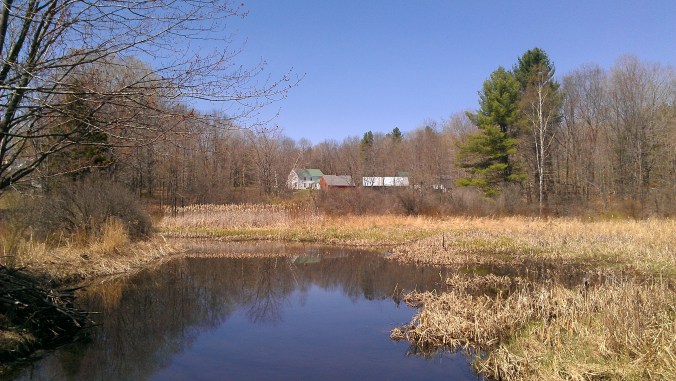
130502 Back Forty Pond

I’ve lived in a few places. Work, family, friends, lovers have all taken me all over but I always have come back to Rowe.  A person I grew up with told me that this town was part of his soul, he hasn’t lived here since 1975.  I know that feeling, where you drive into a place over a familiar road not seen in a while and something happens, you feel it in your gut, that little flutter.  You know you are home.

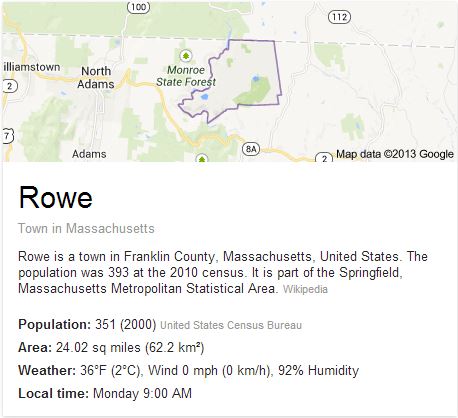
I live in two worlds, fortunately they are close enough in distance so I can escape one for the other. Rowe

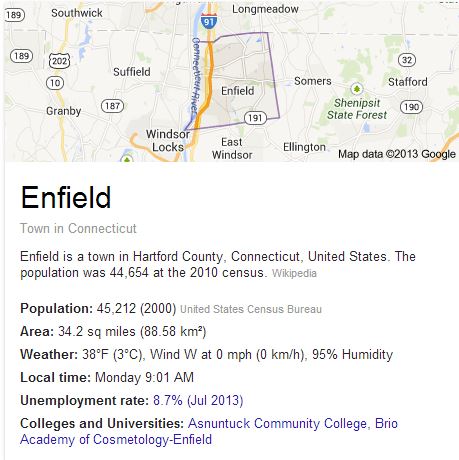
Just for my own comparison I snipped out the vital info about Rowe and Enfield.  Rowe with its 24 square miles and 393 people compared to Enfield with its 34 square miles and 44,654 people at last count. That means there is .49 acres per person in Enfield and 39.09 per person in Rowe.  No wonder I feel like I’m suffocating while I’m in CT.  That’s probably not a fair assessment but it does speak to the rural vs. urban/suburban situation I find myself in.

Enfield, CT

You will also notice the difference in temperature and dew point.  In the summer it’s a difference you notice, in the winter it’s night and day.  The growing season is at least 2 weeks ahead in Enfield.  The last frost is something we see at the end of April.  In Rowe there is nothing that goes into my garden earlier than Memorial Day – ever.

The one difference I truly notice is the quiet (and solitude).  In Enfield there is air traffic over our house close to 24 hours a day – we are on the landing path to Bradley in CT.  I think at night I can see the people sitting in their seats as they fly in for a landing.  The street we live on is very busy and we are within hearing distance of the railroad tracks where Amtrak runs during the day.  Yes, planes, trains and automobiles – the noise never ends.  Everyone is always in a hurry to get nowhere as well.  You have to be a fairly aggressive driver in this harried place.  In our spare time in Enfield we can work on the house (with our neighbors chatting us up over the fence), shop or eat at a chain restaurant.  I used to have very large perennial gardens around the house but it’s not the quiet, meditative project that it is in Rowe.  Now I look at what I can dig up and move, turning the yard back into something that can just be mowed.

When I get home to Rowe everything slows down.  The driving, the breathing, the thinking – once I arrive there is nowhere I need to be but there.  There is enough to keep me occupied for days on end without ever leaving the property.  I breathe the clean air, listen to the birds, contemplate life.  My bedroom window is open at least three seasons so I can hear the owls at night and the birds wake me up in the morning.  I can drink my cup of coffee watching the sun rise over the back forty and the mist dissipate in its heat.

I think everyone needs to find a place of peace if they are not living in it.  I think that’s why people appear to be so crazy right now or they have such health problems.  They are so far removed from the natural world that they are never grounded – at all.  The sad thing is so many never know what it’s like to be grounded in nature, they don’t understand how healing it can be.  I know people I see often that I just want to shake and say “Take an afternoon and go to a state forest and walk, breathe, listen!  Hug a tree, absorb the energy around you.”  And they would look at me with those eyes that say “You are nuts.”