Thanksgiving

671124 Thanksgiving (2)“Gratitude can transform common days into Thanksgiving, turn routine jobs into joy, and change ordinary opportunities into blessings.” William Arthur Ward

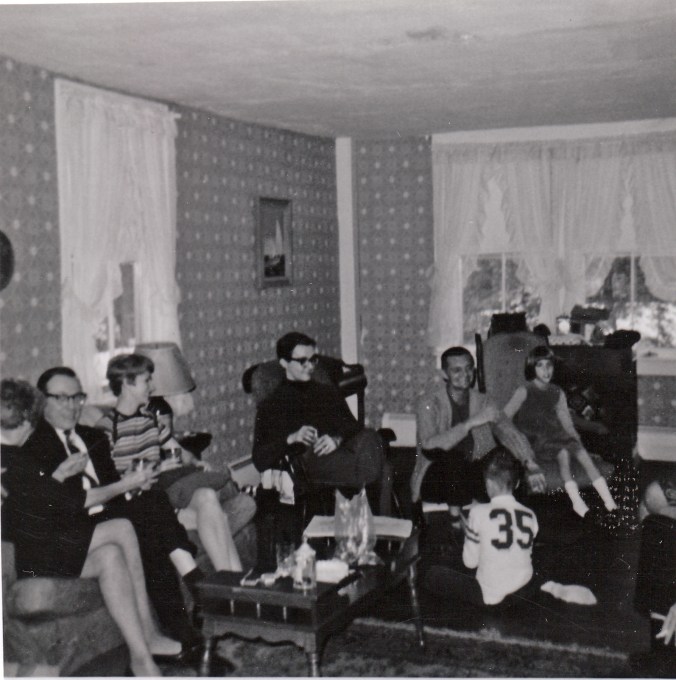
Thanksgiving is my favorite holiday.  It has always been about family for us.  My extended family is small and widespread but as a child the excitement would build over the weeks before the holiday arrived.  Family gathered at Fort Pelham Farm for food and all of the festivities of the season.  My aunts, uncles and grandparents on both sides would arrive one after another in the days before Thursday, our 3 cousins as well.  There was laughter, food, more laughter.  My mother loved this holiday and having her siblings with us.

We would rise early on Thanksgiving day to the smell of Bell’s Seasoning, onions and butter.  My mother had risen at her usual ungodly hour and had everything well in hand.  My aunt would always bring dates stuffed with walnuts and rolled in sugar.  I remember there being a lot of nuts consumed on that day (the only other time we had them was at Christmas or when visiting my mother’s father).  We would consume savory and sweet with the Macy’s parade in the background.

An hour or so before dinner was served everyone changed into their Sunday best.  It was the one meal a year when we “dressed for dinner”.  It seems a little odd to me now but I’m glad we did it.

It is all so long ago and far away now.  Most of those players are gone but having had those gatherings every year of my childhood really instilled in me the importance of giving thanks for family and friends.  I try to be thankful every day but this day focuses on it.

This year we are having the smallest gathering I can remember.  It will be my two daughters, one boyfriend, Bill and I.  It seems to be a pattern with many of our friends and family – I think for us it’s about being home.  We have given up the long distance travelling.  Not so much for getting there but the long ride home.

The bird is in the oven, I started my day with Bell’s Seasoning, onions and butter.  There are vegetables to be cooked, gravy to be made.  The sticky buns are ready to be warmed.  Our meals are always the same, they have been for me for well over 50 years.  I asked the girls what they absolutely had to have for dinner and am making everything we always have for 5 people.  It wouldn’t be a Thanksgiving without the same things we have every year.  There will just be a lot of leftovers – never a bad thing.

Today I am thankful that we have good, local food available to us – some grown right here.  I am thankful I will be spending the weekend with 2 of my children who I see less than I’d like to.  I’m thankful that we are in a huge old house with a cranking woodstove.  I’m thankful for the quiet, the snow and the birds that are gracing my feeder.

I am most thankful for the people in my life.  I’m thankful I have a new piece of my family returned.  I’m so thankful (and miss terribly) the people that are now gone – they made me who I am and made my life richer.

Happy Thanksgiving to all of my friends that read this blog regularly.  Surround yourself with the people that are the most important to you, breathe it in, make it part of that collective memory that sustains you.

Generations of Service

We have someone in our family that has fought in every war from the Revolution except for Vietnam.  Our family tree is full of stories of battles, command of regiments and battalions, unusual jobs.  I can imagine the mothers, wives and daughters caring for property and finance when their men went off to war.

Some were volunteers fighting for things they sincerely believed in, others were drafted.  They all seemed to travel to foreign places returning home with exotic and exciting stories to tell their children and grandchildren. Those stories were part and parcel of my childhood.  Some were just information, others were fantastic tales. We were brought to believe that service to our country was proudly taken on.  They were tales of camaraderie and the craziness of youth.

The things that have stuck with me is that they all saw their times of service as one of the greatest things they ever did.  WWI, WWII, Korea, The Gulf War, Iraq, Afghanistan – these are the stories I know, the ones that I have heard first hand. The stories they tell are always about the men they were with, working as a team for a common cause. Many times that cause was just staying alive.  They tell their stories with a sense of humor and I’ve often thought that it’s a way to keep the fear of those situations in check, or the telling of the stories helps them make sense of them.

This is my father.  He was in the Navy from 1951 until 1954 on the USS Northampton as a boilerman. His story was one of travel to foreign lands.  The war was going on in Korea but he spent his entire tour in the Atlantic – Spain, Greece, Haiti, Cuba.

530901 Dick in Navy

Generation after generation has served.  My brother is still serving.

Thanks to all servicemen and women for the sacrifices you have made and continue to make and the stories you have and share.

Helping Hands

131102 Wood (1)It must look as though all we do is cut, split and stack wood by the numerous posts about it here.  This time of year that does seem to be the case.  I have to tell you though that this is one chore that I kind of like doing.  It is the one thing we do as a little community for the most part.  This weekend we went to sister Sue’s to move some of a huge locust tree that came down at the end of the summer.  The tree guys cut it up in place and hauled away the sticks and branches (the worst part of the job).  They cut the wood to length but it needed to be moved and split.  The morning began with the tractor ride to her house, Bill followed with the splitter.  A friend arrived shortly after we did and then Sue’s daughter and her husband.

The tree was at the back side of her house so Bill, Rob and Chuck all loaded the bucket of the tractor and the bed of a pick up with multiple loads and brought it to the door of the barn where we had set up the splitter.  Sue has a door in the floor of the barn and we split and tossed it through the door into the lower level.  This is really an excellent set up.  It keeps the wood out of the weather and is attached to the house so in those howling snow storms she just has to walk down the stairs to get her wood.  Not ideal going up and down the stairs but much better than keeping it under a tarp in a field somewhere.

Sue and I split the smaller pieces but a lot of it was huge.  The splitter can be used horizontally or vertically.  The vertical position allows you the ability to split any size diameter wood (you just have to be able to move it around).  One large chunk was split into 30 plus pieces – Sue counted. Moving and splitting went on for four hours or so – 3 tanks of gas is how we measure.  The wall of wood was a little intimidating initially, they were bringing it up faster than we were ever going to split it. Bill figures they will get 5 cord or more from that one tree.

This kind of work is fun, especially when you have a group of people working towards that common goal.  It’s nice to work with people that have experience, a lot can be done without a lot of instruction.  Time can be spent working and laughing.  And if you’re with my sister you can bet you will be taking stock of what kinds of mosses are growing on any given piece of wood – I did see her set a piece or two aside for closer inspection later.

131102 Wood (2)

A Side Note on Shared Experience

640701 Ticonderoga (3)


I had to post this, especially after the Nature vs. Nurture thing.  This is one of the experiences that is mentioned to me the most by my father (and probably sister and brother as well).  My father thinks it’s funny that Sue thought we were going to fire her out of the cannon.  As you can see she doesn’t look thrilled.  This was taken at Fort Ticonderoga around the first of July 1964.  Forts were another of the “must see” on our family vacations.  What I remember is the cannon was HOT.  “Let’s sit the kids on the cannon in the midday July sun”.  Probably had third degree burns but never complained.

It’s amazing how this one event has been talked about for almost 50 years – by all of us.  These are the things that make us who we are.

Nature vs. Nurture

130714 (1)

Joseph’s Coat

I have been thinking about my family (my mother, father and siblings) for the last few days.  How we interact with each other, our senses of humor, our interests.  I have always thought that people are who they are because of the lifelong bond they have with each other.  The shared experiences.  My sister, brother and I can relate to so many things because of the memories we have of situations that closely relate to what is happening now.  Or how we saw our parents and grandparents react in different situations. We use our past experiences to make decisions on events or to figure out the social protocol within our social sphere. We also have the same sense of humor. It’s really more than that though, our minds all work alike.

My two daughters grew up spending most of their time with my husband’s side of the family.  They have a lot of cousins their own age and we all spent most weekends together.  They grew up with cousins as best friends.  That’s not a bad thing.  My sister has two daughters around the same age as mine.  They did not spend a lot of time together because of the distance between us or later because of time constraints.  It’s not like they didn’t know their cousins, they just didn’t have the same intimate knowledge of one another as they did with their father’s side of the family.  They didn’t really know their aunt and uncle on my side well at all – only because every holiday we all spent with our respective in-laws.

A couple of years ago one of my nieces was home for the holidays. We hardly see her now – she’s lives on the other side of the country.  My sister’s family came to spend the day with ours.  They brought their dogs.  We spent the entire day laughing.  Once everyone had left my younger daughter said, “I’ve always felt as though I didn’t fit in, now I realize I was just hanging out with the wrong family!”  She had found her place.  The place where you really understand your roots, or why you are the way you are.

This was the beginning of realizing that who we are may be more genetic than environmental.  For years I tried to fit into my husband’s family but they are not who I am.  What we have in common is our children.

Since my son and I have reconnected this realization comes home so often that it is fact to me now.  He has never known his biological family until this past spring and we did not know him.  The first things noticed were the physical attributes but the subtle, personality traits showed up almost immediately.  The day he met my daughters was really a whirlwind but after he left everyone was in agreement – he is one of us.  It all fit.  For us this has been easy, a delightful revelation each time we get together.  We gather him in and never seem to get quite enough, the visits end too quickly, there is so much of us to share.  At the same time I wonder how overwhelming we might be.  How much do you really want to know about a past that never existed until last March?

Since those first few meetings I’ve learned many things about him, about me.  Some things can be looked at as bizarre coincidences but the reality is that we are who we are born to be, not who we spend our lives with.  Our interests, how we communicate with others, our spiritual selves, those seeds were planted at our conception and we in turn pass them along to our children.  My children just happen to be the ones that have made this so abundantly clear to me.

Throw Back Thursday – Tracks and Wrecks

We have a couple of friends who work for the railroad, they are or were engineers for both Amtrak and freight.  They are interesting people to talk to.  I had a conversation one afternoon with one of them about the amount of time I had spent as a kid doing things related to trains or tracks or train wrecks.  I decided to dig through the archives and post just a few of the shots taken in the 60’s and early 70’s of us spending time on tracks.

630701 Trolly Mus Arundel ME (2)On every vacation we would have to stop at something that had to do with tracks – while this wasn’t a train it was a trolley at the Seashore Trolley Museum in Arundel, ME.  It seemed like no matter where we were going on vacation we could always make a stop at a place like this.

640715 Steamtown (3)Of course there was Steamtown, USA located in Bellows Falls, VT which was just close enough so we would go fairly often. It opened in 1963 and these photographs were taken in 1964.

640715 Steamtown (5)We would stand to have our picture taken, but most of the time we would watch my Dad climb all over and sit in the engineers seat on the various engines that were there.

640715 Steamtown (6)In 1984 Steamtown was moved to Scranton, PA and my father and mother made a trip to see it in its new incarnation.  He always knew where those locomotives were or were headed.

670215 Train Wreck (1)Then there were the train wrecks.  These were truly family events for us as kids.  Very rarely would we go with our Dad anywhere except on our once a year vacation.  If there was a wreck within a reasonable driving distance we went.  Often we would go on consecutive nights to see how the clean up was coming along.

670215 Train Wreck (2)This wreck was in Charlemont in the winter of 1967.  This was an exciting time for us.

670215 Train Wreck (3)This was also before the days of lawsuits and liability issues so when there was a wreck it took on a carnival atmosphere (maybe it was because I was a kid that it seemed that way).  People would walk around the wreckage – help clean out box cars taking home whatever they could (they would be called looters now – it was a different time).  We would go at night and watch them work under huge lights, part of a gallery of locals where this was about as much excitement as you could ask for on a February night.

710628 Clark's Trading Post (2)This last photograph was taken at Clark’s Trading Post in Lincoln, NH.  We went there a number of times on vacation but it was only in recent years that I realized it wasn’t because my parents loved Franconia Notch, it was more about going to Clark’s and seeing the locomotive that they had there.  We always had to take a ride on it and I’m sure Dad talked the ear off of the engineer.  While there we would also have to go to Mt. Washington and watch the locomotives for the Cog Railway come and go.  At the time they were steam and pushed the cars up the mountain.

In later years my father bought a 1923 Erie Steam Shovel (like the one in the children’s book  Mike Mulligan and his Steam Shovel).  He complete restored the multiple engines on it, had the boiler re-manufactured and would fire it up occasionally to delight and entertain family and guests.  He would contact the owners of Clark’s and talk with them about it because Clark’s was the only other place that had one that ran.  He sold it a few years ago to a man that wanted to finish the restoration, he didn’t want someone to scrap it.

There are still two large steam power plants on the property – one was used to power the sawmill.  The other was a steam generator he took out of a factory in Vermont.

Steam has been an all encompassing passion of my father’s his entire life.  He had always talked about putting tracks around the property so he could run a locomotive around it.  I always thought that was more to get a rise out of my mother but have come to understand that it was probably a sincere dream of his.  We may have been bored out of our minds on some of those trips to Steamtown but at the same time there is nothing I have found that gives me chills like a steam engine chugging it’s way along the tracks.

On Grandparents

560801 Jo & Mim

My Mimi (Lena Babineau Alix) with me – 1956

Last Friday a long time customer of ours came in to have the oil changed in her car.  She and her husband have been bringing their cars into us for over 25 years.  Her husband passed away a little over a year ago after doing battle with dementia for a number of years.  She was with him 6 days a week for over 3 years at the veterans hospital.

Before his illness they spent a good deal of their time outdoors.  He was an avid fisherman, they had a place in Maine, I believe on a lake.  Family was everything to them and all would spend many, many days fishing with their father/grandfather.

As she reminisced about the days shortly after the death of her husband she told me the first words out of her 12-year-old granddaughter’s mouth were “Who will take me fishing?’.  Father and uncles all said that they would but her response was “But it won’t be the same”.

I felt her granddaughter’s pain.  My grandparents have been gone for many, many years now.  I miss them dearly.  They all had their strengths, the things that they played to.  Grampa was the Red Sox, beer and spanish peanuts, always.  Nan taught me how to embroider, we learned to quilt together, handcrafts were the game.  Pampi always tinkered with things (he was actually quite brilliant in his mechanical ability) and was always ready to laugh.  Mimi was the one I played with, laughed with, hugged, adored. She was the one who I trusted and loved more than the others.  She was always on our level through every age.  When visiting Mimi and Pampi I always felt unconditionally loved, I could do no wrong.

It’s the little things that we remember.  I drank my first cup of tea at their table (really warm milk).  Tea was always ritual with them – a pot was brewed after supper, every night.  We would sit around the table and talk.  We would laugh at Pampi’s antics to get a rise out of the wife he clearly adored.  The great aunts and uncles would visit, tales of the past and gossip of the present would rule, an uncle would slip into French when he was excited. Laughter, always lots of laughter.

One of my nieces was lamenting the fact that her children will never know her Mabel the way she does.  It’s true we said but you never knew our Mimi and that is sad for us.  Each child in each generation has their own experience.  I hope that I am the kind of grandmother that my grandchildren can lament their children not knowing.  I do know that they will probably grow up drinking some sort of hot beverage, sitting around a table and talking about the old days. They will probably also spend a good deal of time outdoors looking at bugs, birds and plants.  I can teach them to use their hands and hopefully their minds and I hope that’s what they’ll remember.

Family Stories


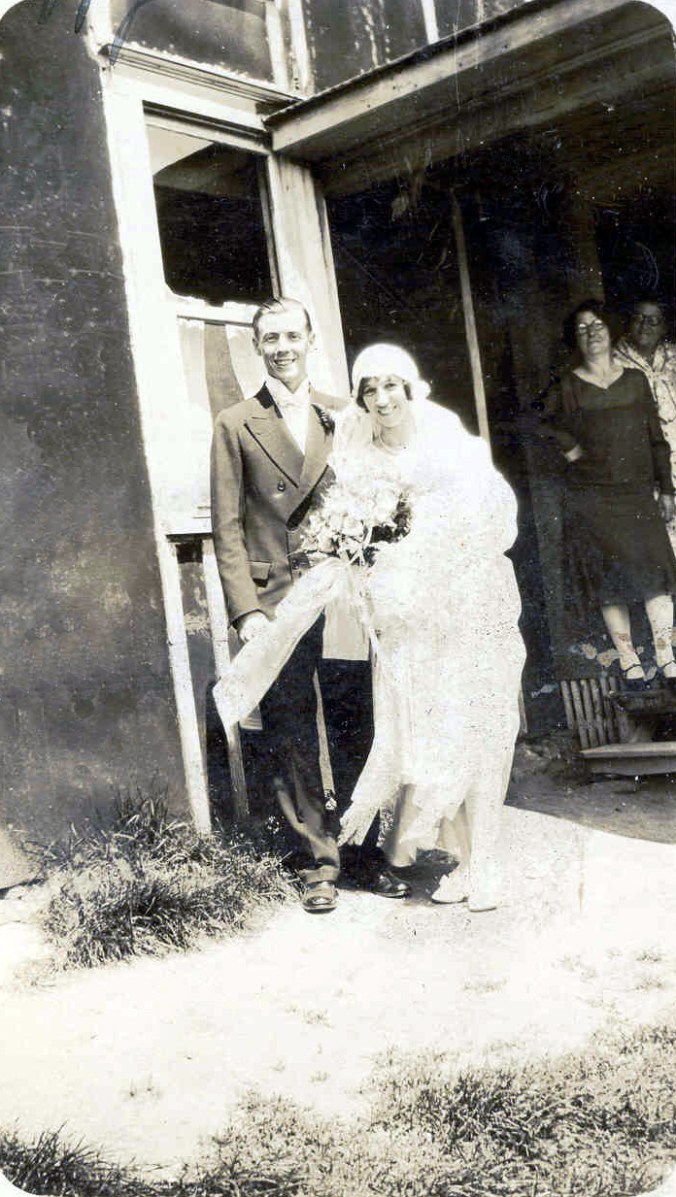
300623 Wedding  Elmer and LenaLena and Elmer Alix – June 29, 1930 – both were working in mills at the time.

Every Wednesday I eat lunch with my Dad at the assisted living facility he lives in now.  It’s always interesting for one reason or another.  This week we talked weaving, which is one of my favorite subjects.  My father is one of the few people left that can tell me the stories of the woolen mills where almost his entire family worked for his childhood, adolescence and young adulthood.

He’s been telling me these stories for my entire life, they are part of my being.  It wasn’t until this past year that I had a much greater understanding of what he was talking about.  He always tells me about the mechanics of the mill, how the looms worked, how the fiber was carded and spun, the kinds of fiber they were using.

When I began my weaving class my goals were twofold – I wanted to learn the process but I also wanted to better understand the stories – my family history.  I knew if I didn’t do this a good part of these stories would be lost.

Wednesday Dad talked about winding warps for the looms.  The looms they were using were 72 inches in width (that’s pretty big). Each warp thread came off of its own spool.  He didn’t know how long the warps were but he often has told me about my grandfather knotting the warp threads as they ran out while beaming the warp. He could tie the knots with one hand.  This must have been pretty amazing because Dad never looks more delighted than when he tells me that.

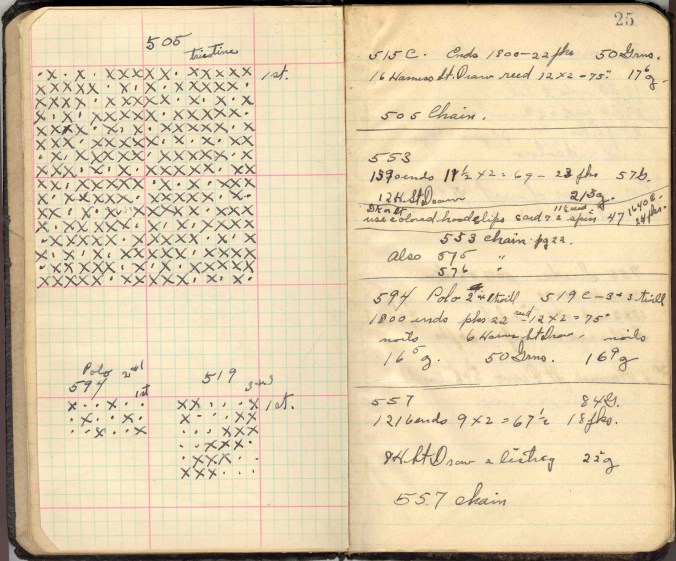
We talked about my grandfather’s weave books. Dad told me this was the book he was using at Charlton Woolen in the early 1930’s.  Today I took it out and realized that the length of the warp was decided by whatever the job was.  This book never ceases to amaze me.  He saw this in his head, he designed on paper and knew what it was going to do – wow.  I understand it but at this point I’m not able to visualized what the warp and weft are going to do without doing a draw down (and I struggle with that at times – it makes my head hurt from thinking too hard).


Weave Instructions (2)


The heddles were all threaded by hand – look at this page – 6 harnesses with 1800 ends. It would take me a month. Yikes!  Often there over a dozen harnesses, talk about making your head hurt.

Today I will finish weaving my scarf for the Eastern States Exposition (Big E).  I will take it off of the loom, fringe it, weave in any loose threads, then wash and block.  I think one of the reasons I enjoy weaving so much is it has helped me to understand the kind of thinking my ancestors did while doing what they did for a living.  This has been a great journey.

Farmher

100808 (39)

In reading a blog I read daily called Sheepy Hollow Farm I was taken to a site called Farmher.  This is a website documenting women farmers in the U.S. and the photographs are stunning.  It got me to thinking about last weekend.

My sister had a pile of wood in her driveway that needed to be split so last Sunday Bill filled the splitter with gas, hooked it up to the tractor and sent me on my way.  I have to admit I love driving the tractor – especially to other people’s houses.  I love the open feeling as you are driving down the road, the way the tractor sounds.

On the way I passed the home of a classmate of mine (there were only 4 of us total until high school).  He was mowing his lawn and I could see on his face that look of bewilderment – “What is she doing towing a splitter down the road with a tractor?”

When I got to Sue’s we unhooked the splitter leaving it near the pile of wood.  We then proceeded across the field to pick up three large pieces of an apple tree trunk.  They filled the bucket.  After dumping them in the pile of wood we started splitting, each taking a turn at running the splitter or bringing the wood over to be split – both throwing the wood into the pile needing to be stacked.  We were about halfway through the pile when my classmate, his wife and daughter walked by with their dog.  We gave a wave but continued on our quest to finish before we ran out of gas (both us and the splitter).  I said they must be wondering about those crazy sisters doing that kind of work.

That’s what I was thinking as I perused the photography of Farmher.  I saw a woman tilling her garden, out with a chainsaw.  I saw them milking goats, feeding chickens, tending gardens and thought this has been me for a good part of my life in one way or another.  In centuries past the woman did a very large part of the farming along with her husband.  They were a team.  The men did the heavy work, the women made sure they were fed and warm.  They all worked hard.  I come from a line of small farmers, it seems to me that this is the way life really should be.  Bringing forth your sustenance from the land that is yours, tending your field and flock.  Knowing that the work you put in keeps your family happy and whole.