Fair Worthy

wp-1471550627027.jpg

Fair season begins tonight.  All entries for the Heath Fair have to be there by 8:00 p.m.  I finished the bear 10 minutes ago.

Every year as I’m doing whatever project I’m doing I always look at it asking if it’s fair worthy.  Does it meet my standards to be shown in public?  By people who know more about what I’m doing than I do?

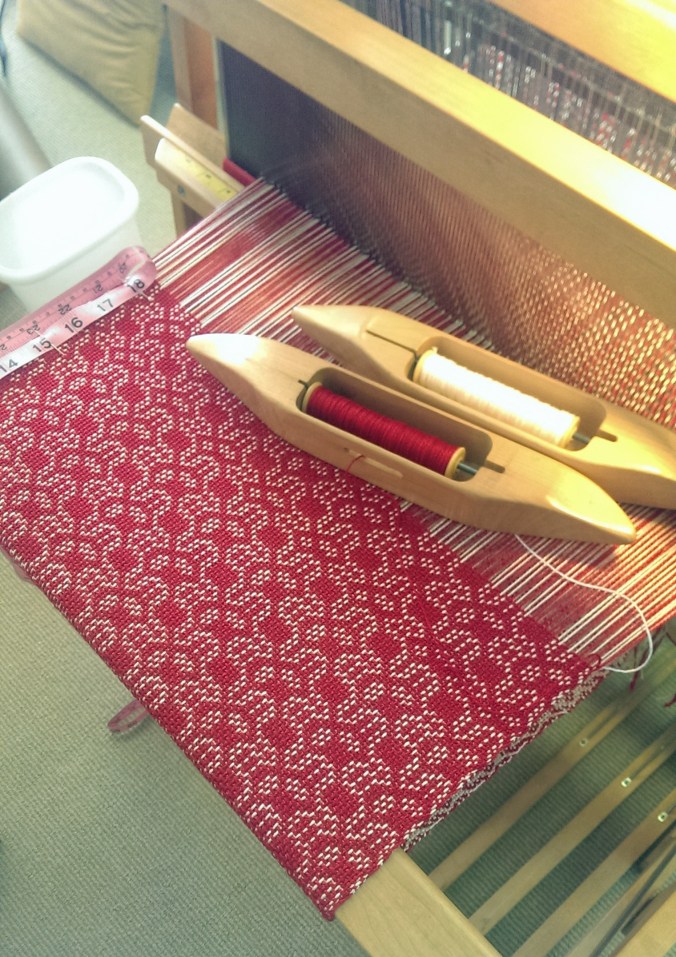
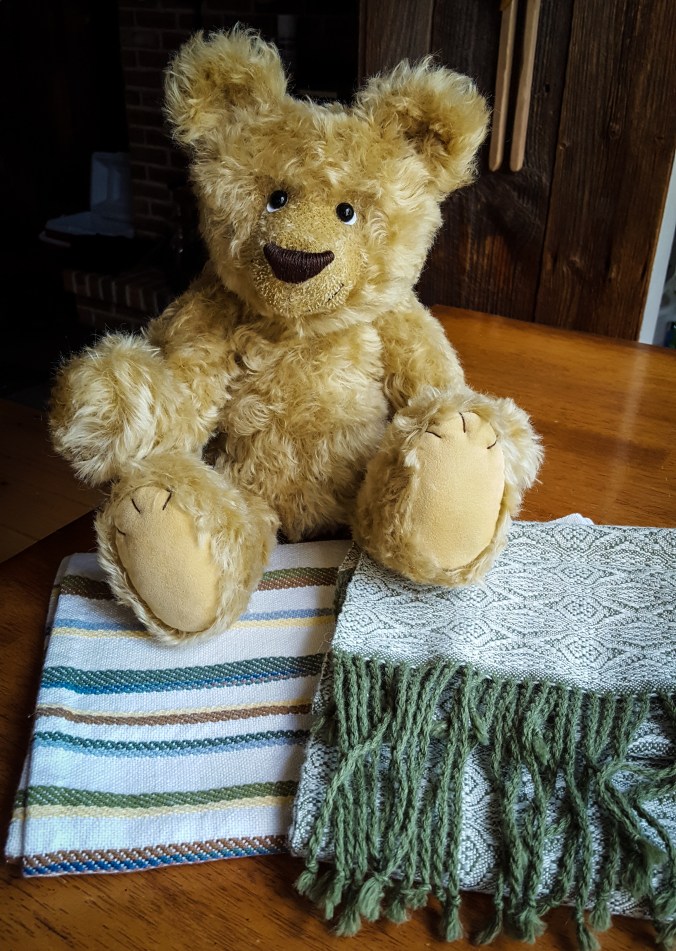
This year there are 3 entries for the Heath Fair and the Big E.  The weaving I knew was worthy as soon as the wet finishing was done.  The bear . . . I decided to sew one when I filled out the entry forms weeks ago but didn’t even begin it until last week.

I have a lot of bears that I’ve made over the years but each entry to the fair has to have been completed since the last fair.  I pulled out materials that haven’t seen the light of day for years and started this little project.  I finished his face (so I thought) and put all of his joints together.  Stuffed his body and sat him on the table where I looked at him every time I walked by.  He was off – the eyes weren’t right, the ears were cockeyed, the nose needed work.  He was not fair worthy.  I didn’t want anyone to look at him and wonder “What hack made this?”.

I thought about not putting him in the fair at all but remembered I had until 8 to get there and knew if he didn’t go in there was a possibility of him spending years in a closet somewhere.  I moved his eyes, stitched down an ear in a better position and spent some more time on the embroidered nose.  I  kind of wished I’d photographed him before I fixed him.  He looked at me with gratitude when I took that last stitch and brushed out his fur.

I’m telling you it’s tough being a perfectionist who anthropomorphizes her stuffed animals.


By the way – Fair bear really could use a name, any suggestions?

It’s Always Something

wp-1463655459822.jpg

It starts with this.  Poorly wound cones of wool.  Not only are the cones badly wound but the wool is not greatly spun.  There are slubs, lots of them – places where the fiber is not twisted and readily comes apart.  That leads to this.

wp-1463535624738.jpg

The yarn breaks while winding it onto the bobbins either due to the slubs or by catching on the tangles that are on the bottoms of the cones.   Or the bad spinning leads to this –

wp-1463655417528.jpg

Endless broken warp threads, endless repairs.

wp-1463655440720.jpg

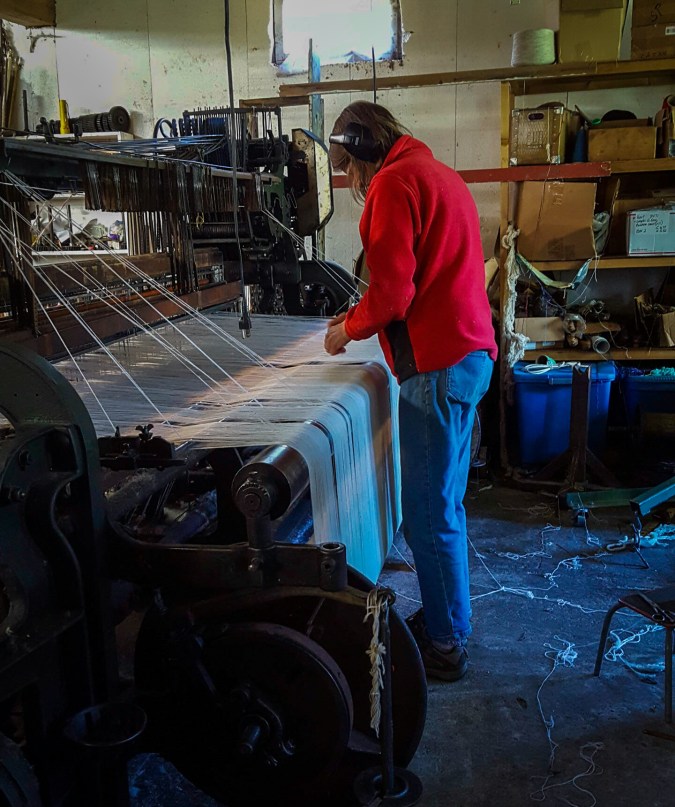
I really should have been helping her instead of taking her picture.  The weaving was a real stop and start affair for the past two days.  One blanket wove with a single broken warp thread, the next had over 30 I would guess.  It often looks like this –

wp-1463655338715.jpg

Then you can have issues that cause mechanical failure – there have been a few broken bobbins lately.

wp-1463655387875.jpg

I have to tell you that makes a pretty ugly sound when it happens.  The other day Peggy suggested my next blog post should be titled “Breaking Bad”.  It made me chuckle and it helps to have a sense of humor when things aren’t going along as well as you’d like but then your morning ends with an image like this – wp-1463679844093.jpg

Crawling under the loom is never good (even if it was highly enlightening for me).  The top of a heddle frame caught and broke while the loom was running, number 16.  I stand and watch for broken threads while it’s running and tell Peggy to stop it, I didn’t even see this happen.  There is so much to look at while the machine is running – so much.  We moved the threaded heddles to the frame in back of it (thankfully unused) and took the frame apart and off of the loom.

I learned a lot from this particular incident.  First, experience is everything, Peggy knows where to be looking or knows the sound of a happy or not so happy machine.  Second, this is no game for an older person in questionable physical condition.  I could have gotten under the loom but the question remains, how long would it have taken me to get back up?

Then there is the question of just how long can you run machinery that there are no longer parts for?  With the best running practices things are still going to break.  There are piles of loom parts in the barn where the looms are located but it’s not like you can just order something up on-line when you need to.  I supposed the metal parts could be reproduced by a skilled machinist, but at what cost?  Then there are the bobbins which I daresay were discarded quite often in a running mill.  Who makes those now?

I feel privileged to be able to experience this first hand but am saddened by the knowledge that this is truly the end of the road for this weaving (unless I’ve missed something).  I’m not saying it ends this year or next but the end is visible.  The day you can no longer fix this loom is the day is becomes a ton and a half of scrap metal and that is sad indeed.


Manic

wp-1463657742940.jpg

A couple of days ago I finished a 10 yard run of towels and took them off of the loom, hemmed, washed and folded them all in one afternoon.  This never happens, I have things I have yet to finish from last year.

When I near the end of one project I’m always moving on to the next and my excitement may get in the way of the finishing part.  That’s my theory anyway.  I’m in wedding present mode and asked one of my nieces if there was anything in particular I could make her that would be useful.  She asked for a specific type of towel.  I asked what colors and she said something to the effect of light shining through ferns.  She is an amazing artist and thinking about projects for her pushes me creatively.

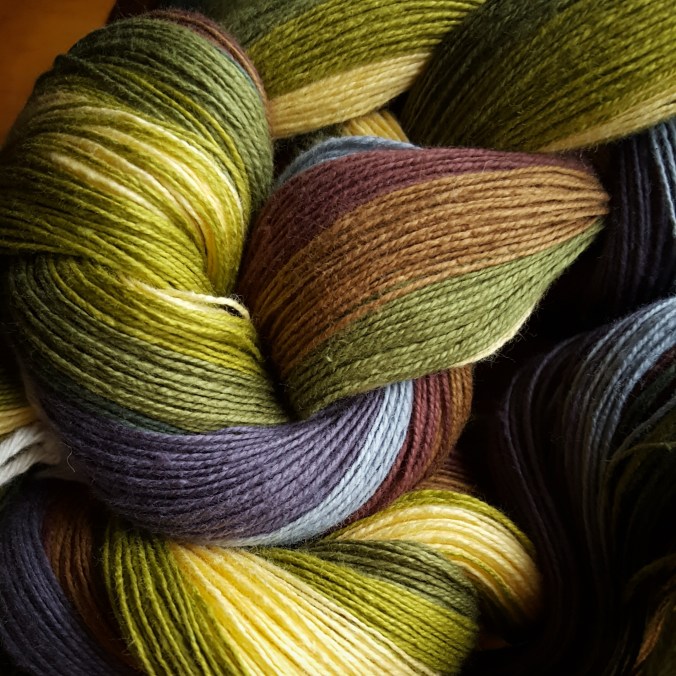
I found a modification of an old draft that I modified further and worked up half a warp yesterday hoping this came close to ferns.  As I was winding it I decided to call it “A Walk in the Woods” because it had the colors I envisioned when I walk onto the fern lined path headed into the wood lot in the back forty.

wp-1463657742944.jpg

Today I’ll finish winding the warp and possibly get it onto the loom.

Right now I’m in that creative manic mode that seems to really set in after a loss.  When my mother died I made quilts and rag dolls – lots of them.  I gave most of them away to my friends.  Again, it’s the process, not the product.  Weaving seems to be what’s on the agenda right now although I do have a knitting project going as well as needle felting, rug hooking and, oh yeah, the gardens.

This time around though there’s a different sort of feel – like time is getting short and there’s still so much I want to do.  Maybe it’s that generational shift that comes when you lose your last parent.  Maybe it’s the realization that if you’re lucky you have a quarter of your life left to go and who knows how productive all of it will be.

Most of the time I don’t really think about it but on those days when all I can think about is the project I’m planning and working on to the point of no sleep it does make me wonder.  I think some of it is a distraction, maybe a defense to fight off the depression that could take over or the overwhelming sadness at moments.  What’s the saying? “Idle hands are the devil’s workshop”.  I just have to keep going, keep creating.

Calling in the Expert

wp-1463313705205.jpg

With a mechanical problem with a vintage loom there are times you need to have someone look at the equipment that knows it so well he can fix things with his eyes shut (or diagnose it over the phone).

I met Lenny this past weekend when he came over to make a few adjustments that would help with the changing of the bobbins in the shuttles.

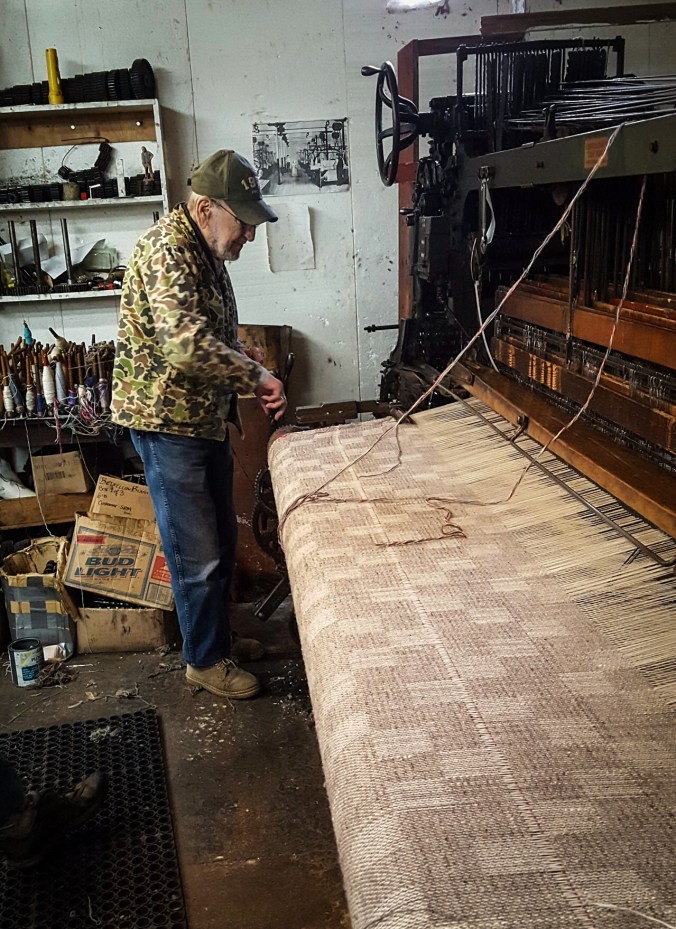
wp-1463313840919.jpgLenny is the spryest 90-year-old I have ever met.  Steady, agile, clear of mind and he knows his looms.  He should, he’s been working on them for 76 years.  He made a couple of adjustments, ran the loom a little, made a couple more and made a suggestion on changing how we wind the bobbins.  Today everything ran the way it should.

wp-1463313808527.jpg

Along with the fix we were treated to some serious reminiscing about the mills.  The noise, the work, the different types of looms he had worked on.  Being a loom mechanic or fixer was probably one of the most important jobs in a mill and it takes a person with the right type of mind to be one.

Lenny is different in his love for the machines.  He’s never stopped – loving them, working on them, restoring them.  You can see it in his face when they are running.  There’s the look of delight you so rarely see except in the eyes of a child.

As he was leaving he looked at me and said “Well, that was a bit of fun!”.

We all need a passion in life that does that for us. That one thing that brings a broad smile to our face.  That’s something that has continually evolved for me, I like learning new things – new crafts and bringing them to perfection.  It’s always something with my hands producing something that can be amazing.

wp-1463313621182.jpg

Lenny knows what he knows but he loves what he does and the product it produces.  I think that love is what has kept him so young.


Loving the Mechanics

160513 Loom (1)

I’ve always had a fascination for things mechanical, things with lots of parts that move together to make something happen.  My father’s sawmill running on steam was a sight to behold – so much motion.

Today I watched the loom in action.  There have been a few minor set backs to this particular job but I love how it makes your brain work to solve a problem or two.  Being able to watch it work was another step towards understanding what it can do.  Everything has its limitations but you have to understand how it works before you can troubleshoot the problems.

As it ran and I observed it almost made me laugh out loud.  So, so many moving parts all working together.  This is a machine that was improved over time back in the day when it was practical engineering minds that were tweaking it here and there or redesigning parts of the whole to make it work better, faster, more efficiently.  These were men whose minds understood gear ratios, tension, pulleys, levers.  They knew how to make things work without a degree in engineering.

I dare say a loom mechanic was not that different from a car mechanic.  They worked on the same machine day in and day out.  Most times fixing similar problems or the parts that typically wore out.  My grandfather’s tool box has all kinds of little things in it that I’m sure were a lot of his job.  There are boxes of bigger parts in the barn here as well.  Until today I didn’t know what they were.

Watching this work is mesmerizing, there is so much going on at the same time.  It makes me sad to think of what younger people are missing with so much now replaced with electronics.

Okay, I’m really going to date myself here but I remember when Bill and I bought our first cd player.  It was another big component to add to the already massive stereo that people had back then.  We put the cd in and listened to the clean sound but we had to come to terms with the fact that we had no idea how it worked – none, it might as well have been some sort of magic.  It was disconcerting in a way to not understand how something works, especially for two mechanically minded people.  We decided to just accept that we were never going to know and move on.

Winding bobbins on the mechanical bobbin winder, listening to the loom running, walking around it to see everything moving top to bottom I couldn’t help but think that this is the magic that people are missing out on.  This is just plain fun to watch.

Divine Intervention

W3 Loom

It all started with a little black book filled with cloth samples and drafts – my grandfather’s sample book.  I’ve been moving it with me since his death in 1976. None of it made any sense to me.

Four years ago a highschool friend posted on Facebook that she had a Harrisville loom for sale.  I had always wanted to learn and it seemed like the right opportunity.  I then went about looking for a weaving teacher that taught on that particular loom.  As luck would have it there was one in a town that was relatively close.  My first visit to the weaving group on Tuesday nights I brought that little black book and told Pam, my teacher, that I wanted to learn to weave so I would understand the book.  She told me that wouldn’t be a problem and someday I might be able to weave my way through the drafts in the book.

I read an article recently about genetic memory.  The basic principle is we carry the ability to do complex tasks around in our dna, handed down from generation to generation.  I’m not sure about people who are born savants but I do know that weaving felt like something I already knew and understood on a visceral level.  It was something that was already there, it just needed to be unlocked.

Now I love to weaving but if I’m honest it’s really about the looms. I love troubleshooting problems.  Figure out how one works and make it work better.  Since I started weaving I have also amassed quite the collection of looms.  All but one are in working order and I use most of them, one is a restoration project without room to put it so it waits.

During this whole weaving learning experience I started to write about it, mostly to spark conversations with my dad about the mills my family members had all worked in.  My fascination for the machinery of the mill grew.  He would explain to me how they worked with vivid descriptions.  If I found a video of a power-loom in action he would point out the things he was trying to describe.  For me it was the sound of the loom running that drew me in.  I have a vivid memory of that sound from early childhood when I would be taken to my grandfather’s mill.  It was loud and amazing.

Well dad is gone and so are the stories and I needed something to keep it alive for me.  Pam asked me to go to a weaver’s guild meeting the week after my father died because Peggy Hart was going to be giving a talk.  I went, for many different reasons.  One – because Pam asked me to. Two – hoping to hear the stories. Three – to meet Peggy, someone my father had repeatedly said to meet because she had the looms.

I met her there, called her the following week and visited her mill a few days later (it’s very close to home, who knew?).  I was there for a tour really and it turned into an apprenticeship.  She needs help, I want to learn to run the machines.

This morning I spent 3 hours or so learning to wind bobbins, putting them into the loom, repairing broken threads and listening to it run.  I can only describe that sound to me as being wrapped in a warm hug.

Timing is everything.  I had called Peggy over a year ago to meet her and see her mill because my father was badgering me to do it.  For one reason or another it never happened.  As it turns out I would never have had the time to give to this then.  Peggy lost her weaving assistant recently (he’s 90) and has more jobs ahead of her than usual.  As I was leaving today we were talking about scheduling and she said, “I think you have come into my life at the perfect time.” My reply, “For me as well.” It feels like divine intervention.
The Love of Handwork

151021 Baskets

Fall has come and gone up in the hills – we are now entering the halcyon days.  Days with that feeling of urgency to get things done before the snow flies.  There are a handful of projects that I really should get done before dark today but a post from a friend struck such a chord with me this morning I needed to share it.

Screw Finding Your Passion by Mark Manson was a post that was music to my ears.  It’s something I’ve known intuitively my entire adult life yet I’d bought into what others had told me.  I needed a plan, I should find what I love to do and make a living doing that.  In the back of my mind I was sort of calling bullshit because my passions are many.  They are always evolving.   I am one of those people who moves from craft to craft but will only move on when the obsession has brought what I consider perfection.  I will work a skill to its highest level I know.

I’ve been this way my entire life.  Focus and move on.  The problem is that as far as society is concerned what I’ve focused on has never been a way “to make a living”.  I think the reality is there are many ways to make a living and without a passion for something it sometimes doesn’t seem worth it.  I’ve almost always worked a job that was less than exciting while I pursued my passions.

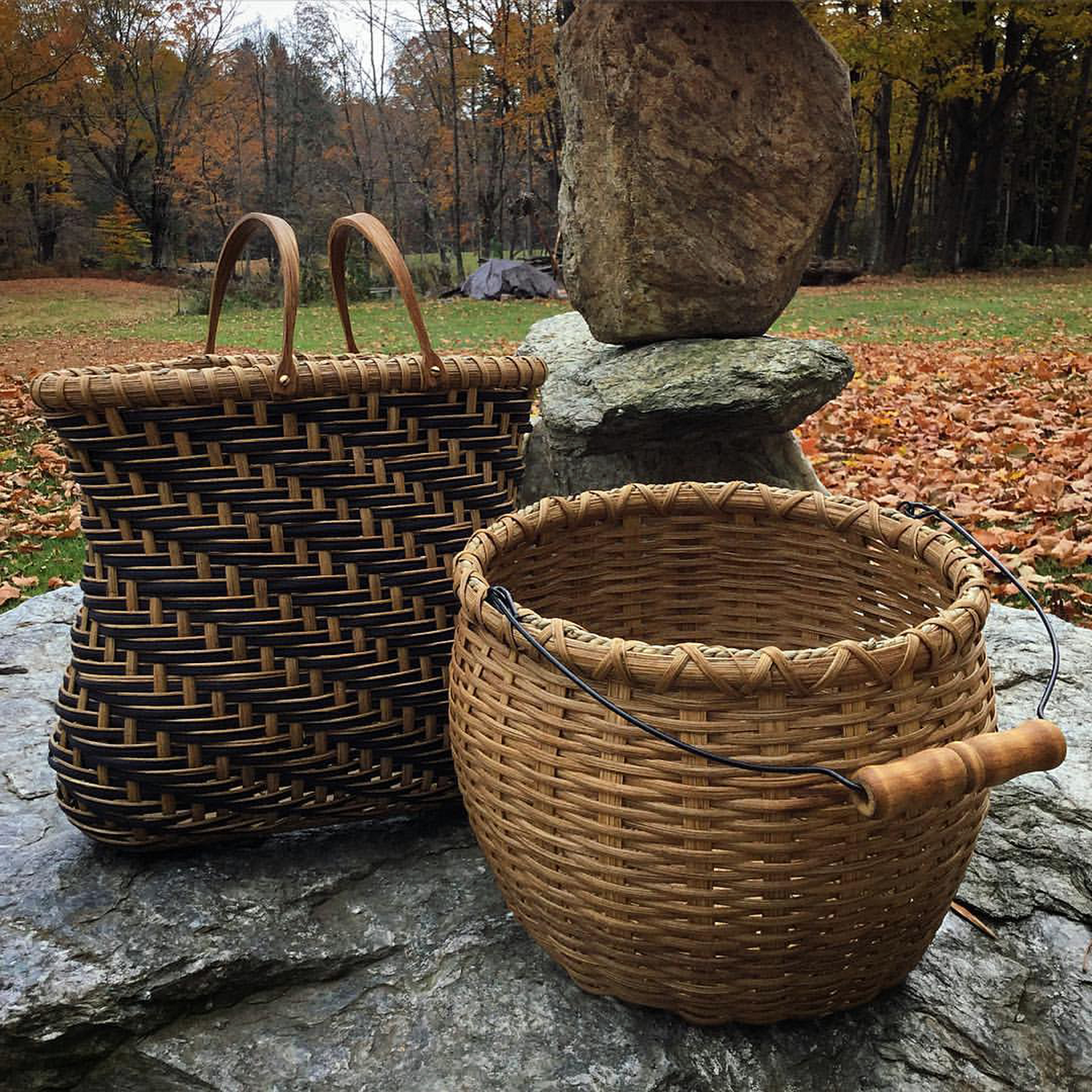
I’ve recently begun weaving baskets again after a twenty year or more hiatus.  Basketry goes hand in hand with weaving textiles – all have the same structure, just different materials.  Baskets are 3 dimensional, practical and the materials are fairly inexpensive.  I could go harvest things in my back forty to weave and it’s been just another reason to go for a walk about to see what’s out there.  Always a different way to see.

With so many years of crafting under my belt I have found now that my real passion is for teaching others to do these things.  I feel everyone should make something with their hands – to feel the satisfaction of a finished product unique to them.  Learning a craft expands your way of thinking, exercises your brain.  As we get older I think we all need to continually learn something new.

I’ve begun teaching people to weave baskets, of all kinds.  I started by conning my daughter and grandson into making one.  Making these things is an all day affair so it’s not always easy to convince someone it’s worth doing.

150815 Baskets Cait and Francis

Yes, they were smiling here but by the end they were grumbling.  I look at this as planting seeds.  I was asked why would they need to know how to do this?  I told them they now had skills – if they ever needed a vessel they would know how to make one.  And their vessels were beautiful and I think they both walked away proud of that they accomplished.  Maybe some day they will want to make another.

I put out a message on social media that if anyone wanted to learn to make a basket to contact me and we would do it.  People responded and I am teaching which is good but there has been a huge unexpected bonus.

Weeks after I shared I’d be doing this I was contacted by a dear friend from several lifetimes ago.  I had not seen or spoken to her for over 18 years.  She was visiting her sister and they wanted to make a trip to Fort Pelham Farm to make a basket.

151023 Baskets with Linda and Vicky

The results speaks for itself but I have to say that the passion for weaving baskets has changed from the crafting of the basket itself to the crafting and cultivation of friendships, new and old.  Honestly, that’s something I can truly be passionate about.

Make Something Beautiful

150531 Basket Workshop (4)

A few months ago I signed up for a day long basket weaving workshop with the majority of  my weaving class.  I’ve just fallen in love with these women, all around my age and many in similar life circumstances.  What I really love is they are always willing to learn something new.

Our workshop was with Wendy Jenson in her studio in Monterey, MA.  She is an amazing weaver, her baskets are stunningly beautiful and she is a wonderful teacher.

150531 Basket Workshop (1)

I’ve woven baskets before, many years ago.  The real reason I wanted to do this was to hang out with a bunch of creatives, all learning something new.  What’s really great is weaving is weaving.  The concepts translate into all kinds of different things so I think everyone had a leg up on those who have never woven anything before.  That, and these women are game for anything.

150531 Basket Workshop (2)

There was a choice of two different basket designs, a Williamsburg or a Carry All.  I chose the latter and was surprised at how the skills learned 25 years ago come back to some extent.  Everyone did a great job on their projects and I have to think we all went home happy with what we learned and what we made.

I really think the most important thing is to make the time to create something out of raw materials.  What started out as a bundle of flat reed was transformed in a few hours to a beautiful basket.  During that time of working with your hands you also work through the troubles of the day, week or month.  In this case with friends as therapists working alongside you.  When finished it feels as though all your troubles and cares have been poured into what you’ve created.  You have a memento of time well spent.

150531 Basket Workshop (3)

Weaving Hooks and Eyes

150113 Hooks and Eyes(2)

The last time I posted about this particular project I had left it wondering what the heck I was doing wrong because the pattern wasn’t looking quite like the draft.  My weaving instructor looked at it (under the cloak of darkness) and emailed me that I had been treadling it wrong.  I was close but not quite right.

The structure for this project comes from a back issue of Weaver’s Craft – Issue 11 Vol. 3, No. 1 Spring 2002.  I’ve added a link for my weaving friends because so many people asked me to explain it.  Honestly, I’m not deep enough into the project to do so.  I had an aha moment while I was weaving the other day (and doing it properly).  I realized when throwing the white shuttle that I was weaving the same pattern on the back side.  How cool is that?

150113 Hooks and Eyes(3)

I love the thickness of this fabric – perfect for placemats.  They will be totally reversible, light on one side, dark on the other.

The best thing about this structure for me is that I can use any overshot pattern and weave something that doesn’t have long floats that snag and pull.  Perfect for baby blankets, table linens, anything that will be used regularly.  Overshot has enough complexity to keep me interested while weaving and looks far more complicated than it is.  Threading and weaving requires a little more concentration but it’s totally worth it in the end as you can see.

Some Warping Stupidity

150109 Warp

A couple of days ago I decided it was time to put another project on the loom.  I have a nephew that’s expecting twins in the spring and opted for an overshot blanket.  I wound a 6 yard warp in 5/2 figuring I would weave two in different colors and have some room to play as well.  I was warping the loom this time using a roll of corrugated cardboard.  It went on like a dream, straight, even, perfect tension, yes!

I taped up my draft and started threading my heddles.  Hmmmm, there really didn’t seem like enough threads for the project.  I got halfway through and realized I had miscounted. By half. Ugh.

Now I’ve been known to wind a warp that was twice the number of threads but never under.  So I’m thinking, “What the heck am I going to do now – there’s 6 yards on here and 230 threads?”

It just so happens I was also planning on doing a couple of table runners for gifts later in the winter but there weren’t enough threads to do the ones I intended.  This sent me in search of an overshot pattern that would work for the people the gifts were intended for and spoke about the weaver (this is almost always how my design process goes).

I pulled out Weaving Designs by Bertha Gray Hayes.  This is my all time favorite book of overshot patterns.  I pored through the book for a good long while and finally settled on her pattern Old Fashioned Garden.  It has a 40 thread repeat so I could work it with an open and close of 14 threads and only have 15 threads hanging off the back of the loom in the end.

Today I’ll thread the heddles, tie on and hopefully weave enough picks to see how the design will work.

The babies will have to wait.

150109 Macomber

As a side note I just wanted to share how amazing this Macomber loom is.  The breast beam is hinged and can be lowered.  Great when you’re ready to thread and really don’t want to take the loom apart.  This loom is so high that I wouldn’t be able to thread over the beam comfortably.  There are so many things about this loom that are simply brilliant in their design.